Adaptive AI Instructional Systems and Student Emotional Well-Being The Mediating Role of Classroom Engagement in K12 and Higher Education
Huangzhengxi,Liujingya,Wangfangxin,Wangzinan*
Qingdao Hengxing University of Science and Technology
*e-mail:wzn010@126.com
Abstract:This study investigates the relationship between adaptive AI instructional systems and student emotional well-being, with a focus on the mediating role of classroom engagement across K12 and higher education. Drawing on self-determination theory and constructivist learning theory, a cross-sectional survey was conducted with 1,126 valid responses from 658 K12 students and 468 higher education students. The results indicate that adaptive AI systems significantly and positively predict both student emotional well-being and classroom engagement. Classroom engagement partially mediates the relationship between adaptive AI systems and emotional well-being in both educational stages. Moreover, multi-group analysis reveals significant stage heterogeneity: the positive effects and mediating mechanisms are stronger in K12 than in higher education. These findings highlight the importance of personalized intelligent teaching technologies in promoting students’ positive emotional development and underscore the critical transmission role of classroom engagement. The study provides theoretical contributions to intelligent education and educational psychology, as well as practical guidance for differentiated application of adaptive AI systems across educational stages.
Keywords:adaptive AI instructional systems; student emotional well-being; classroom engagement; K12 and higher education
1. Introduction
1.1 Research Background: Digital Empowerment Reshapes Modern Educational Ecology
The in-depth integration of artificial intelligence and education has triggered a comprehensive reform of teaching modes, learning scenarios and educational evaluation systems worldwide. Traditional education is restricted by fixed teaching schedules, unified curriculum standards and limited teacher energy, making it difficult to accurately match the personalized learning needs of students at different ages and cognitive levels[1]. In traditional classroom scenarios, students often face problems such as inconsistent learning progress, mismatched difficulty of teaching content and single interactive mode, which easily lead to learning anxiety, low learning confidence and negative emotional experiences, hindering the improvement of students’ comprehensive literacy and healthy psychological development.
Adaptive AI instructional systems, as a new generation of intelligent educational technology, break through the limitations of traditional teaching modes relying on big data analysis, machine learning algorithms and user portrait construction. These systems can real-timely monitor students’ learning duration, answer accuracy, resource browsing habits and interactive feedback behaviors, dynamically identify individual learning advantages and deficiencies, and automatically adjust teaching difficulty, knowledge presentation form and learning task arrangement. In K12 basic education stage, adaptive AI systems assist teachers in carrying out hierarchical teaching and personalized tutoring, reducing students’ learning frustration caused by mismatched learning difficulty. In higher education stage, such systems support autonomous and exploratory learning, help college students formulate personalized learning plans for professional courses, and adapt to the diversified learning needs of talent cultivation in higher education[2-4].
Emotional well-being is an indispensable dimension of students’ holistic development, which is closely related to students’ learning motivation, academic adaptation and mental health level. In the context of intelligent education, the impact of technological changes on students’ emotional state has become a hot issue in current educational research. Existing studies have confirmed that reasonable application of educational technology can optimize learning experience and enhance positive learning emotions, while improper technical intervention may also cause learning dependence, information overload and other problems, inducing negative emotions such as learning burnout and anxiety. Therefore, it is urgent to systematically explore the specific impact mechanism of adaptive AI instructional systems on students’ emotional well-being.
1.2 Research Gaps: Unresolved Problems in Current Intelligent Education Research
Current domestic and foreign studies on adaptive AI instructional systems mainly focus on the optimization of teaching effects, the improvement of academic performance and the innovation of teaching modes. Most studies verify the positive role of adaptive AI technology in improving learning efficiency and optimizing teaching processes, but there are relatively few in-depth studies on students’ psychological and emotional development[5]. In terms of emotional well-being research, existing literature mostly discusses the influencing factors from the perspectives of teacher-student relationship, classroom atmosphere and family education, and lacks systematic analysis of the technological environmental factors represented by adaptive AI instructional systems.
Moreover, most previous studies ignore the intermediary transmission mechanism between adaptive AI systems and emotional well-being, and fail to clarify how intelligent teaching technology affects students’ emotional state through specific learning behaviors and learning states. Classroom engagement, as a core variable connecting teaching environment and student development, is a key bridge to explain the internal influence path of educational technology on emotional well-being[6]. However, few studies have incorporated classroom engagement into the research framework of adaptive AI teaching and emotional well-being, and have not verified its mediating effect.
In addition, existing related studies often take a single educational stage as the research object, lacking comparative analysis of K12 and higher education scenarios. Students in different educational stages have significant differences in cognitive ability, learning autonomy and emotional regulation characteristics, and the application effects of adaptive AI systems and their influence on emotional well-being may also have stage heterogeneity. The lack of comparative research restricts the universality and targetedness of research conclusions, and cannot provide differentiated practical guidance for intelligent teaching in different educational stages.
1.3 Research Significance: Theoretical Innovation and Practical Value
In terms of theoretical significance, this study constructs a complete theoretical framework of “adaptive AI instructional systems-classroom engagement-student emotional well-being”, clarifies the direct and indirect influencing paths of intelligent educational technology on students’ emotional development, makes up for the research gaps in the intersection of intelligent education and educational psychology, and enriches the theoretical system of technology-enabled student holistic development[7]. At the same time, this study compares the differences of influencing mechanisms between K12 and higher education stages, which can further expand the application scope of adaptive learning theory and emotional development theory, and provide new theoretical perspectives for follow-up related research.
In terms of practical significance, this study systematically verifies the positive effect of adaptive AI instructional systems on students’ emotional well-being, and clarifies the key role of classroom engagement in the transmission process. The research conclusions can provide targeted optimization suggestions for the design and application of adaptive AI teaching systems, help educational institutions and teachers rationally utilize intelligent teaching tools, optimize classroom teaching links, and improve students’ behavioral, cognitive and emotional engagement in classroom learning. In addition, the stage difference research results can guide K12 schools and universities to formulate differentiated intelligent teaching strategies, effectively alleviate students’ negative learning emotions, promote the healthy development of students’ emotional well-being, and finally realize the integration of intelligent teaching innovation and student mental health education.
1.4 Research Framework and Core Hypotheses
This study takes students in K12 and higher education stages as the research objects, takes adaptive AI instructional systems as the independent variable, student emotional well-being as the dependent variable, and classroom engagement as the mediating variable. Through literature sorting, theoretical deduction and empirical test, this study analyzes the direct influence of independent variable on dependent variable, the influence of independent variable on mediating variable, and the joint indirect influence of mediating variable on dependent variable, and compares the path differences between different educational stages. Based on the above theoretical analysis, the core research hypotheses of this study are proposed as follows:
H1: Adaptive AI instructional systems have a significant positive predictive effect on student emotional well-being in both K12 and higher education.
H2: Adaptive AI instructional systems have a significant positive predictive effect on classroom engagement in both K12 and higher education.
H3: Classroom engagement has a significant positive predictive effect on student emotional well-being in both K12 and higher education.
H4: Classroom engagement plays a significant partial mediating role between adaptive AI instructional systems and student emotional well-being in both educational stages, and there are significant differences in mediating effect values between K12 and higher education.
2. Literature Review and Theoretical Foundation
2.1 Systematic Review of Adaptive AI Instructional Systems Research
Adaptive AI instructional systems are intelligent teaching platforms that integrate artificial intelligence, educational big data and adaptive learning theory. Different from traditional computer-assisted teaching systems, the core feature of adaptive AI instructional systems is “student-centered” dynamic adaptation, covering content adaptation, rhythm adaptation, strategy adaptation and evaluation adaptation. Content adaptation means that the system adjusts the difficulty and type of learning knowledge points according to students’ cognitive level and learning foundation; rhythm adaptation refers to matching personalized learning progress according to students’ learning speed and attention state; strategy adaptation means selecting targeted teaching methods such as video explanation, interactive exercise and case analysis according to students’ learning habits; evaluation adaptation realizes dynamic learning evaluation and real-time feedback based on students’ learning performance.
In foreign research, adaptive AI instructional systems have been widely applied in basic education and higher education teaching practice. Relevant foreign studies have shown that adaptive AI teaching tools can effectively solve the problem of heterogeneous learning in large-class teaching, significantly improve students’ learning initiative and learning efficiency, and optimize classroom teaching effects. Domestic research on adaptive AI instructional systems started relatively late, but has developed rapidly in recent years. Existing domestic studies mostly focus on teaching practice application and teaching effect verification, confirming that adaptive AI systems have positive application value in hierarchical teaching, personalized tutoring and precise teaching management[8-10].
However, most existing studies focus on cognitive learning outcomes such as academic performance and learning efficiency, and pay insufficient attention to the affective development outcomes of students. Few studies explore the long-term impact of adaptive AI teaching modes on students’ emotional state and psychological development, which limits the comprehensive evaluation of the educational value of adaptive AI instructional systems.
2.2 Comprehensive Review of Student Emotional Well-Being Research
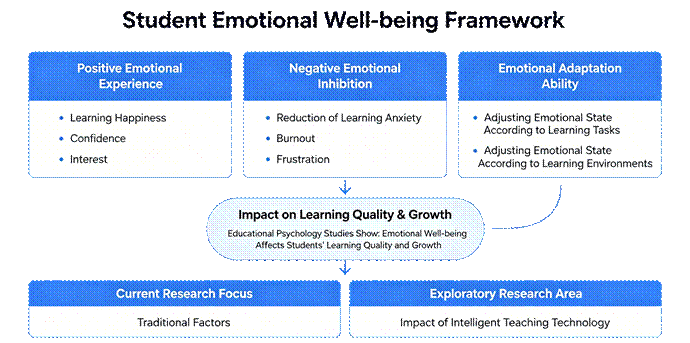
Student emotional well-being is a multi-dimensional and dynamic psychological state, referring to students’ positive emotional experience and good psychological adaptation in learning and campus life. It has three core dimensions: positive emotional experience (including learning happiness, confidence, and interest), negative emotional inhibition (ability to reduce learning anxiety, burnout, and frustration), and emotional adaptation ability (adjusting emotional state according to learning tasks and environments).
Educational psychology studies show emotional well-being affects students’ learning quality and growth. Students with high well-being have stronger motivation, better persistence, and higher participation. Conversely, long – term negative emotions lead to reduced enthusiasm, poor performance, and psychological problems. In the digital education era, teaching changes affect students’ emotions, and technology is a new influencing variable[11].
Current research on student emotional well – being focuses on traditional factors. Research on the impact of intelligent teaching technology is in the exploratory stage, lacking systematic empirical research and mechanism analysis, providing a research space for this study.
2.3 In – depth Review of Classroom Engagement Research
Classroom engagement is a comprehensive learning state with three interrelated dimensions: behavioral engagement (external participation like answering questions), cognitive engagement (deep thinking and intellectual investment), and emotional engagement (emotional immersion and positive experience).
Classroom engagement is an important intermediate variable in education, affected by teaching environment, mode, and teacher behavior, and can predict students’ learning and psychological development. Optimized teaching and innovative modes improve engagement, which is positively correlated with students’ emotional well – being.
In intelligent teaching, adaptive AI systems change classroom interaction and learning modes, affecting students’ engagement. However, the relationship between adaptive AI systems, classroom engagement, and emotional well – being lacks systematic empirical verification, which is the core problem of this study.
2.4 Theoretical Basis and Logical Deduction
This study is based on self – determination theory and constructivist learning theory. Self – determination theory states that individual motivation and emotional state rely on the satisfaction of autonomy, competence and relatedness needs. Adaptive AI instructional systems offer autonomous learning space and personalized paths for students, meet autonomy needs; reduce learning difficulties via targeted matching and tutoring, meet competence needs; build a positive learning environment through interactive feedback and task design, meet relatedness needs, and promote positive emotional well – being. Constructivist learning theory emphasizes learning as an active knowledge – construction process, with learning engagement as the core. Adaptive AI instructional systems create a personalized learning environment, guide students’ active exploration and participation, improve classroom engagement. High – quality classroom engagement optimizes learning experience, reduces negative emotions and enhances well – being. Based on this, the study deduces the mediating role of classroom engagement between adaptive AI instructional systems and student emotional well – being and constructs the research theoretical model.
3. Research Design and Methodology
3.1 Research Objects and Sample Selection
This study adopts a cross-sectional survey research method, taking K12 students (primary and secondary school students) and higher education students (undergraduate and postgraduate students) who have used adaptive AI instructional systems as research objects. In order to ensure the representativeness and effectiveness of the sample, this study selects 6 primary and secondary schools and 3 comprehensive universities in different regions of China to carry out questionnaire survey, covering urban and rural schools, key and ordinary schools, to avoid sample homogeneity.
A total of 1200 questionnaires were distributed in this survey, including 700 for K12 stage and 500 for higher education stage[12]. After eliminating invalid questionnaires such as missing key information, regular filling and inconsistent logical answers, 1126 valid questionnaires were finally recovered, with an effective recovery rate of 93.83%. Among them, 658 valid samples were from K12 stage, accounting for 58.44% of the total sample; 468 valid samples were from higher education stage, accounting for 41.56% of the total sample. The basic demographic information of the sample is shown in Table 1.
| Variable | Category | K12 Sample (N=658) | Higher Education Sample (N=468) | Total Proportion (%) |
| Gender | Male | 342 | 241 | 51.78 |
| Female | 316 | 227 | 48.22 | |
| Learning Stage | Primary School | 215 | 0 | 19.09 |
| Middle School | 443 | 0 | 39.34 | |
| University | 0 | 468 | 41.57 | |
| AI System Usage Frequency | Low (1-2 times/week) | 186 | 124 | 27.53 |
| Medium (3-4 times/week) | 327 | 219 | 48.49 | |
| High (5-7 times/week) | 145 | 125 | 23.98 |
Table 1 Basic Demographic Information of Research Samples
3.2 Variable Measurement Tools
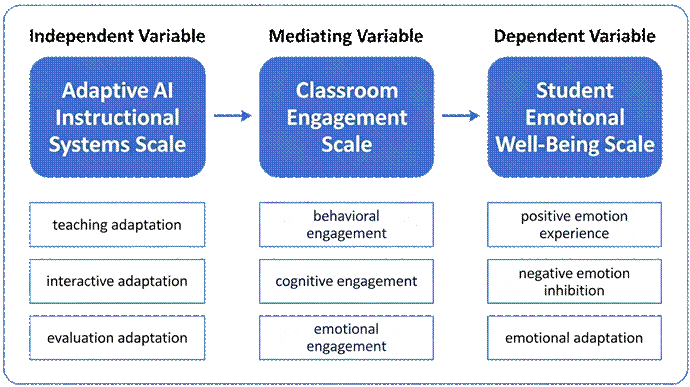
In order to ensure the reliability and validity of research data, all measurement scales adopted in this study are mature international and domestic authoritative scales, which are appropriately revised according to the research theme and educational stage characteristics, and all items adopt 5-point Likert scoring method (1=strongly disagree, 2=disagree, 3=neutral, 4=agree, 5=strongly agree).
First, the independent variable scale: Adaptive AI Instructional Systems Scale. This scale is compiled based on adaptive learning theory and intelligent teaching evaluation standards, including three dimensions: teaching adaptation, interactive adaptation and evaluation adaptation, with 18 measurement items in total. Teaching adaptation items focus on the matching degree of system teaching content and individual learning level; interactive adaptation items measure the intelligence and pertinence of system classroom interaction; evaluation adaptation items investigate the timeliness and accuracy of system learning evaluation and feedback.
Second, the dependent variable scale: Student Emotional Well-Being Scale. This scale is revised on the basis of the classic emotional well-being measurement scale in educational psychology, including three dimensions: positive emotion experience, negative emotion inhibition and emotional adaptation, with 15 measurement items in total. It is used to comprehensively evaluate students’ emotional state and psychological adaptation level in the process of using adaptive AI teaching systems.
Third, the mediating variable scale: Classroom Engagement Scale. This scale adopts the widely used classroom engagement three-dimensional measurement framework, including behavioral engagement, cognitive engagement and emotional engagement, with 16 measurement items in total. It comprehensively measures students’ overall classroom learning investment state under the adaptive AI teaching mode.
This study uses SPSS 26.0 and PROCESS macro program for data statistical analysis, and the specific analysis steps are as follows: first, carry out reliability and validity test of all measurement scales to verify the stability and effectiveness of questionnaire data; second, conduct descriptive statistical analysis and correlation analysis of core variables to preliminarily judge the correlation between variables; third, construct regression models to test the direct influence of independent variable on dependent variable and mediating variable; fourth, use the bootstrap method to test the mediating effect of classroom engagement; finally, conduct multi-group comparison analysis to explore the differences of influencing paths between K12 and higher education stages.
3.4 Reliability and Validity Test
In order to ensure the scientificity of empirical research results, this study tests the reliability and validity of all scales. Reliability is measured by Cronbach’s α coefficient. Generally, when α coefficient is greater than 0.7, the scale has good internal consistency reliability. Validity is tested by construct validity through exploratory factor analysis. The test results of reliability and validity are shown in Table 2.
| Variable | Dimension | Item Number | Cronbach’s α | KMO Value | Bartlett Sphericity Test (p) |
| Adaptive AI Instructional Systems | Teaching Adaptation | 6 | 0.826 | 0.852 | 0.000 |
| Interactive Adaptation | 6 | 0.819 | |||
| Evaluation Adaptation | 6 | 0.833 | |||
| Classroom Engagement | Behavioral Engagement | 5 | 0.807 | 0.837 | 0.000 |
| Cognitive Engagement | 6 | 0.821 | |||
| Emotional Engagement | 5 | 0.815 | |||
| Student Emotional Well-Being | Positive Emotion Experience | 5 | 0.831 | 0.845 | 0.000 |
| Negative Emotion Inhibition | 5 | 0.809 | |||
| Emotional Adaptation | 5 | 0.824 |
Table 2 Reliability and Validity Test Results of Scales
It can be seen from Table 2 that the Cronbach’s α coefficients of all dimensions of the three core variables are greater than 0.8, indicating that the scales have excellent internal consistency reliability. The KMO values of all variables are greater than 0.8, and the p-values of Bartlett sphericity test are all less than 0.001, reaching the significant level, indicating that the sample data is suitable for factor analysis, and the scales have good construct validity. The above test results prove that the measurement data of this study is reliable and effective, which can support subsequent empirical analysis.
4. Empirical Results and Data Analysis
4.1 Descriptive Statistical Analysis of Core Variables
This study firstly conducts descriptive statistical analysis on the mean value, standard deviation, skewness and kurtosis of core variables in K12 and higher education samples, so as to grasp the overall level and distribution characteristics of each variable. The specific statistical results are shown in Table 3.
| Variable | Sample Group | Mean | Std. Deviation | Skewness | Kurtosis |
| Adaptive AI Instructional Systems | K12 | 3.826 | 0.513 | -0.215 | 0.186 |
| Higher Education | 3.614 | 0.587 | -0.189 | 0.153 | |
| Classroom Engagement | K12 | 3.758 | 0.542 | -0.243 | 0.201 |
| Higher Education | 3.529 | 0.605 | -0.207 | 0.172 | |
| Student Emotional Well-Being | K12 | 3.801 | 0.526 | -0.228 | 0.194 |
| Higher Education | 3.587 | 0.592 | -0.196 | 0.165 |
Table 3 Descriptive Statistical Results of Core Variables
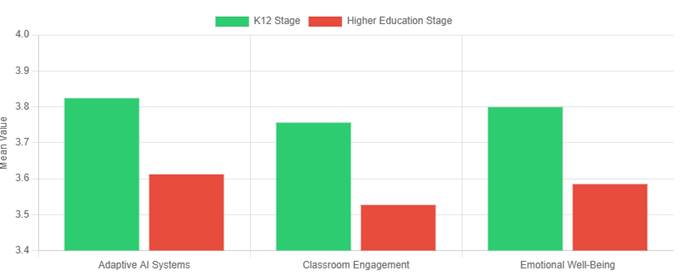
From the descriptive statistical results, the mean values of adaptive AI instructional systems, classroom engagement and student emotional well-being in K12 samples are all higher than those in higher education samples, indicating that the application effect of adaptive AI systems and students’ corresponding learning state and emotional state are better in K12 educational stage. The skewness and kurtosis values of all variables are within the standard range, indicating that the sample data obeys normal distribution, which meets the basic requirements of subsequent regression analysis and mediating effect test.
4.2 Correlation Analysis of Core Variables
In order to preliminarily verify the correlation between variables, this study conducts Pearson correlation analysis on adaptive AI instructional systems, classroom engagement and student emotional well-being in two sample groups. The results show that in both K12 and higher education samples, adaptive AI instructional systems are significantly positively correlated with classroom engagement (r>0, p<0.001), adaptive AI instructional systems are significantly positively correlated with student emotional well-being (r>0, p<0.001), and classroom engagement is significantly positively correlated with student emotional well-being (r>0, p<0.001). The significant positive correlation between variables lays a good data foundation for the subsequent mediating effect test, which is consistent with the theoretical hypothesis of this study.
4.3 Direct Effect Test of Variables
This study takes gender and AI system usage frequency as control variables, and constructs multiple linear regression models to test the direct influence of adaptive AI instructional systems on student emotional well-being and classroom engagement, and the influence of classroom engagement on student emotional well-being.
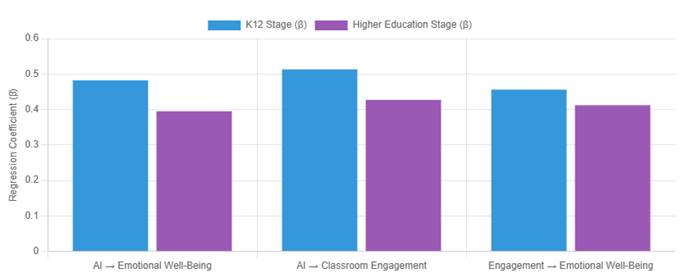
In the K12 sample group, the regression results show that adaptive AI instructional systems significantly positively predict student emotional well-being (β=0.482, p<0.001), and hypothesis H1 is valid; adaptive AI instructional systems significantly positively predict classroom engagement (β=0.513, p<0.001), hypothesis H2 is valid; classroom engagement significantly positively predicts student emotional well-being (β=0.456, p<0.001), hypothesis H3 is valid.
In the higher education sample group, the regression results show that adaptive AI instructional systems also significantly positively predict student emotional well-being (β=0.395, p<0.001), adaptive AI instructional systems significantly positively predict classroom engagement (β=0.427, p<0.001), and classroom engagement significantly positively predicts student emotional well-being (β=0.412, p<0.001). Hypotheses H1, H2 and H3 are all valid in higher education stage, but the regression coefficient values of each path are lower than those in K12 stage, indicating that the direct influence intensity of variables has stage differences.
4.4 Mediating Effect Test of Classroom Engagement
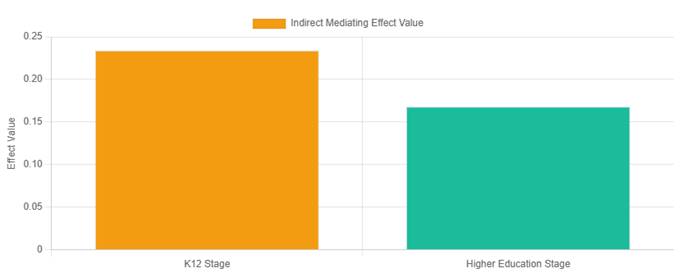
This study adopts the bootstrap method with repeated sampling 5000 times to test the mediating effect of classroom engagement. If the 95% confidence interval of the mediating effect value does not contain 0, the mediating effect is significant. The test results show that in the K12 sample group, the indirect effect value of adaptive AI instructional systems on student emotional well-being through classroom engagement is 0.234, and the 95% confidence interval is [0.187, 0.286], excluding 0, indicating that the mediating effect is significant. In the higher education sample group, the indirect effect value is 0.168, and the 95% confidence interval is [0.121, 0.223], excluding 0, and the mediating effect is also significant.
Combined with the direct effect test results, after adding the mediating variable of classroom engagement, the direct predictive effect of adaptive AI instructional systems on student emotional well-being is still significant in both sample groups, which proves that classroom engagement plays a partial mediating role between the two variables, and hypothesis H4 is fully valid[13]. Meanwhile, the mediating effect value of K12 stage is significantly higher than that of higher education stage, which verifies the stage difference of mediating effect.
4.5 Multi-Group Comparative Analysis of Educational Stages
In order to further clarify the differences of influence mechanisms between different educational stages, this study conducts multi-group path comparison analysis. The results show that the overall fitting effect of the model is good (χ²/df=2.135, RMSEA=0.042, CFI=0.958, TLI=0.947). The path coefficients of adaptive AI instructional systems on classroom engagement and emotional well-being in K12 stage are significantly higher than those in higher education stage. The possible reason is that K12 students have weaker autonomous learning ability and are more dependent on external teaching environment and intelligent teaching tools. The personalized adaptation of adaptive AI systems can more significantly optimize their classroom engagement state and emotional experience. College students have stronger autonomous learning awareness and more diversified learning modes, so the influence of single intelligent teaching system on their learning state and emotional state is relatively weakened[14].
5.1 Direct Influence of Adaptive AI Systems on Emotional Well-Being
The research results confirm that adaptive AI instructional systems can significantly improve students’ emotional well-being in both K12 and higher education stages. This conclusion verifies the applicability of self-determination theory in intelligent education scenarios. Adaptive AI instructional systems break through the limitations of traditional unified teaching, fully meet students’ autonomous learning needs, competency improvement needs and interactive communication needs through personalized content adaptation, rhythm adjustment and intelligent feedback. In the traditional teaching mode, students are in a passive learning state for a long time, and the mismatch between teaching content and personal level is easy to cause learning frustration and anxiety. Adaptive AI systems accurately locate individual learning problems, formulate targeted learning plans, reduce students’ learning pressure and difficulty, help students obtain continuous learning sense of achievement, enhance learning confidence and positive emotional experience, and effectively inhibit negative learning emotions, so as to improve the overall level of emotional well-being.
At the same time, the study finds that the direct promotion effect of adaptive AI systems in K12 stage is more significant than that in higher education stage. K12 students are in a critical period of emotional development, with fragile emotional state and obvious susceptibility to external teaching environment. The warm, personalized and low-pressure learning environment created by adaptive AI systems can effectively protect their positive learning emotions. College students have mature emotional regulation ability and rich learning experience, and their emotional well-being is affected by multiple factors such as academic pressure, employment expectation and interpersonal relationship, so the single influence of intelligent teaching technology is relatively limited[15].
5.2 Mediating Mechanism of Classroom Engagement
This study verifies the partial mediating role of classroom engagement between adaptive AI instructional systems and student emotional well-being, which clarifies the internal transmission mechanism of intelligent educational technology affecting students’ emotional development. Adaptive AI instructional systems firstly optimize students’ classroom learning state and improve their behavioral, cognitive and emotional engagement in classroom learning. In terms of behavioral engagement, the diversified interactive forms and hierarchical task design of adaptive AI systems stimulate students’ learning participation willingness, improve their active classroom participation frequency; in terms of cognitive engagement, the personalized knowledge push and targeted problem training guide students to carry out deep thinking and active knowledge exploration; in terms of emotional engagement, the real-time positive feedback and personalized encouragement of the system enhance students’ classroom learning identity and immersion.
The continuous improvement of classroom engagement further optimizes students’ emotional well-being. High-level classroom engagement means that students are fully invested in learning activities, can continuously obtain learning growth and sense of accomplishment in the learning process, effectively avoid negative emotions such as learning weariness and anxiety caused by passive learning and low investment, and maintain a stable and positive emotional state. This mediating mechanism explains that the influence of adaptive AI instructional systems on students’ emotional development is not only a direct technical empowerment effect, but also an indirect optimization effect realized by improving students’ core learning state in the classroom.
5.3 Stage Heterogeneity of Influence Mechanisms
The multi-group comparison results show that there are significant stage differences in the influence paths of adaptive AI instructional systems on emotional well-being through classroom engagement. The mediating effect of classroom engagement in K12 stage is stronger than that in higher education stage. The core reason lies in the different learning characteristics of students in different educational stages. K12 classroom learning is highly dependent on teacher teaching and platform assistance, and the intelligent optimization of teaching systems can directly and significantly change students’ classroom engagement state, and then drive the significant improvement of emotional well-being.
College students’ classroom learning has the characteristics of autonomy, exploration and diversity. Their classroom engagement is affected by professional interest, learning goal and curriculum value perception. The role of adaptive AI systems in optimizing classroom engagement is relatively limited, so the indirect promotion effect on emotional well-being is weakened. This stage heterogeneity reminds educators that differentiated intelligent teaching strategies must be adopted for different educational stages to maximize the educational value of adaptive AI systems.
6. Research Conclusions and Educational Implications
Based on the empirical analysis of 1126 valid samples in K12 and higher education stages, this study draws the following core conclusions: First, adaptive AI instructional systems have significant positive predictive effect on student emotional well-being and classroom engagement in both K12 and higher education educational scenarios, which can effectively optimize students’ classroom learning state and promote positive emotional development. Second, classroom engagement plays a significant partial mediating role between adaptive AI instructional systems and student emotional well-being, that is, adaptive AI systems can not only directly improve students’ emotional well-being, but also indirectly promote emotional well-being by enhancing students’ classroom engagement level. Third, there are significant stage differences in the influence mechanisms. The direct effect and mediating effect of adaptive AI instructional systems in K12 stage are significantly stronger than those in higher education stage, showing obvious stage heterogeneity.
6.2 Practical Educational Implications
First, optimize the functional design of adaptive AI instructional systems. For K12 basic education, focus on personalized adaptation of teaching difficulty and interactive feedback, create a positive classroom environment to stimulate students’ interest. For higher education, enrich exploratory and research – based teaching functions to meet students’ autonomous learning needs and promote emotional well – being.
Second, take classroom engagement as the core to build an intelligent teaching optimization system. Educators should use adaptive AI technology to design diverse tasks and links, improve students’ classroom participation. Teachers should adjust teaching strategies based on data feedback to enhance students’ learning gain and improve classroom quality and emotional well – being.
Third, build differentiated intelligent teaching management mechanisms. In K12, increase the application of adaptive AI systems to assist students’ mental health education. In higher education, rationally arrange the application, integrate technology with curriculum teaching to build a diversified system.
6.3 Research Limitations and Future Prospects
This study has innovations but also limitations. First, the cross – sectional survey can’t reflect the long – term dynamic change of students’ classroom engagement and emotional well – being. Future research can use longitudinal tracking methods.
Second, the study only discusses classroom engagement as a mediator and doesn’t involve other variables. Future research can incorporate more variables to build a more complete model.
Third, the research sample is limited, and the universality of conclusions needs verification. Future research can expand the sample scope and conduct cross – regional and cross – type school research.
With the deepening of educational digital transformation, adaptive AI instructional systems support modern personalized teaching and student development. This study explores the relationship between these systems and student emotional well – being, and verifies the mediating role of classroom engagement in K12 and higher education. Results show that such systems optimize teaching, improve performance, and promote students’ positive emotional development. Classroom engagement is a key link for intelligent educational technology to benefit students’ mental health. The study reveals the stage heterogeneity of the influence mechanism, offering practical guidance for differentiated application. In future intelligent education, educators should center on students, combine students’ cognitive and emotional characteristics at different stages, optimize the application of adaptive AI systems, focus on enhancing classroom engagement, integrate intelligent teaching innovation with emotional health education, and promote students’ comprehensive, healthy, and sustainable development in the digital era.
References
[1]Wang B Y ,Gao J F ,Li H Z . Exploring the Teaching Path of the Systems Engineering Course Empowered by Generative Artificial Intelligence[J].Education Reform and Development,2026,8 (4):14-23.
[2]Kumari M . Generative Artificial Intelligence in Education: Opportunities, Risks and Pedagogical Implications: A Systematic Review[J].Asian Journal of Education and Social Studies,2026,52 (6):110-120.
[3]Tang M ,Yang X . Physical activity, emotional eating, screen-based sedentary behavior, and physical and mental health in chinese university students: a cross-sectional study.[J].Scientific reports,2026.
[4] AI platforms reshape decision-making across energy and scientific systems[J].Oil & Gas News,2026,
[5]Yuanyuan Y ,Ying Y . Application and effectiveness analysis of AI Intelligent tutoring system combined with knowledge graph in basic medical pathology teaching.[J].BMC medical education,2026.
[6]Rasool A ,Ahmad F ,Bunterngchit C , et al. Challenges in translating AI-driven ASD/ADHD diagnosis: A methodological systematic review.[J].International journal of medical informatics,2026,214 106417.
[7]Lin H ,Zhen Z . Stressors and mental health in Chinese medical students: the mediating roles of positive and negative affect and moderating role of positive coping.[J].BMC psychology,2026.
[8]Chen L ,Ke W ,Li G , et al. A latent profile analysis of physical activity participation patterns and mental health among university students: the mediating role of emotion regulation.[J].Scientific reports,2026,16 (1):10706-10706.
[9]Lu T ,Xiao Y . Analysis of dance movement teaching support system based on artificial intelligence and wearable technology[J].Discover Artificial Intelligence,2026,6 (1):407-407.
[10]Dai D ,Zhou Q ,Tuersun Y , et al. Negative emotional symptoms and e-Health literacy among Chinese college students: a latent profile analysis[J].Frontiers in Psychology,2026,17 1760468-1760468.
[11]Carter M K ,Schoemann M A ,Dembowski A , et al. Psychometric Properties of the Social Emotional Health Survey–Primary: A Strengths-Based Assessment of Student Covitality[J].Assessment for Effective Intervention,2026,51 (2):59-66.
[12]Zuo J H ,Liu T T ,Zhang Y D , et al. Behavior-psychological linkages: how health literacy enhances life satisfaction in Chinese university students through the mediation of persistent exercise and emotional management ability[J].Frontiers in Psychology,2026,17 1706872-1706872.
[13]Xu Z ,Chen F ,Li W , et al. Emotional intelligence and its impact on the mental health of Chinese medical students: a questionnaire study.[J].BMC medical education,2026,26 (1):224-224.
[14]Guo J ,Pan Y ,Zhao Y , et al. Emotional regulation and mental health profiles among Chinese junior middle school students: evidence for the dual-factor model[J].Frontiers in Psychology,2026,16 1708381-1708381.
[15]Jayangi L ,Ganegoda D U ,Amarasekara D T . Emotional intelligence and academic self-efficacy among allied health undergraduates in Sri Lanka: a cross-sectional study.[J].BMC medical education,2026,26 (1):191-191.