Xiaxia Peng
Xi’an Jiaotong University, Xi’an, Shaanxi,710049,China;
Suzhou University, Suzhou, Anhui,234000,China
aEmail: s2025092618@163.com
Abstract:Policy surveillance serves as the foundational institutional mechanism for supervising, evaluating, and optimizing the implementation of state civil statutes, while legal precision constitutes the core criterion for measuring the scientificity, standardization, and enforceability of policy surveillance practices. Citation integrity and internal coherence are two indispensable dimensional indicators of legal precision in state civil statute surveillance. The former focuses on the standardized application, traceability, and authoritative validity of legal citation in surveillance work, while the latter emphasizes the logical consistency, institutional compatibility, and normative unity of the entire civil statute system at the state level. This study systematically explores the connotation, structural dimensions, and practical value of legal precision in policy surveillance, analyzes the common defects of citation disorder and internal incoherence in current state civil statute surveillance, constructs a quantitative evaluation system for citation integrity and internal coherence, and proposes targeted optimization paths for legal precision improvement. Through empirical analysis of state civil law surveillance data, this paper verifies the interactive relationship between citation standardization, institutional coherence and surveillance effectiveness, aiming to provide theoretical support and practical norms for improving the rule of law level of state civil policy governance. The full text adheres to the logical framework of theoretical interpretation, empirical analysis, problem diagnosis and path optimization, with standardized data verification and normative legal reasoning, ensuring the rigor and practicability of the research conclusions.
1. Introduction: Defining Legal Precision for Civil Policy Surveillance
1.1 The Institutional Value of Precision in Civil Statute Surveillance
State civil statutes regulate core social relations including civil subject rights and obligations, property transactions, personal status, and tort liability, constituting the basic legal system that maintains social order, protects civil rights, and standardizes market behaviors. Policy surveillance, as a dynamic supervision mechanism running through the formulation, implementation, revision and abolition of state civil statutes, undertakes the important functions of identifying legal loopholes, correcting implementation deviations, and optimizing institutional design[1-3]. In the context of comprehensive rule of law construction, the traditional extensive policy surveillance model that relies on empirical judgment and qualitative inspection can no longer adapt to the refined governance requirements of modern civil legal systems. Legal precision, as the essential attribute of standardized legal supervision, has become a key benchmark to measure the effectiveness of state civil statute surveillance[4].
Precision in civil policy surveillance is embodied in the whole-process standardized operation of supervision standards, supervision procedures, legal basis and result evaluation. It requires that all surveillance behaviors must be based on valid legal provisions, follow rigorous logical norms, and form traceable and verifiable supervision conclusions. The lack of legal precision will directly lead to ambiguous supervision basis, inconsistent judgment standards, untrustworthy supervision results, and further trigger problems such as uneven implementation of state civil statutes, conflicting institutional norms, and unprotected civil legitimate rights and interests[5]. Therefore, strengthening the construction of legal precision in policy surveillance is an inevitable requirement for standardizing civil law enforcement practices, improving the quality of civil legal system construction, and promoting the modernization of national governance capacity.
1.2 Dual Core Connotation: Citation Integrity and Internal Coherence
Legal precision in state civil statute policy surveillance is supported by two core dimensional elements: citation integrity and internal coherence, which are independent and interrelated, jointly constructing the complete evaluation system of surveillance legal standardization. Citation integrity refers to the normative, complete, accurate and traceable application of legal citation in all links of policy surveillance, including the accuracy of cited legal provisions, the standardization of citation format, the completeness of citation basis, and the timeliness of cited legal documents. It is the basic technical guarantee for the legalization of surveillance behaviors and the most intuitive embodiment of legal precision in surveillance work[6-8].
Internal coherence refers to the logical consistency, normative compatibility and institutional unity of the entire state civil statute system in the process of policy formulation, implementation and supervision. It requires that there is no logical conflict, normative contradiction or institutional vacuum between different civil statutes at the same level, between new and old statutes, and between general provisions and special provisions. It also requires that the supervision standards and judgment criteria applied in policy surveillance maintain consistent logical orientation and value pursuit. If citation integrity solves the problem of “standardized basis of single supervision behavior”, internal coherence solves the problem of “systematic unity of overall supervision system”, and the organic combination of the two realizes the full coverage of legal precision in policy surveillance.
1.3 Research Framework and Core Innovation
This study takes legal precision as the main research line, takes citation integrity and internal coherence as the dual core breakthrough points, and constructs a research framework of “theoretical connotation – empirical measurement – problem diagnosis – path optimization”. Firstly, it sorts out the theoretical basis and dimensional division of legal precision in civil policy surveillance, and clarifies the internal logical relationship between citation integrity, internal coherence and surveillance precision. Secondly, it constructs a quantitative evaluation index system, measures the current situation of legal precision of state civil statute surveillance through empirical data, and identifies prominent practical problems. Thirdly, it analyzes the institutional and technical causes of citation defects and incoherence of civil statutes. Finally, it puts forward systematic optimization strategies from institutional norms, technical empowerment and supervision mechanism improvement[9].
The core innovation of this research is reflected in two aspects: first, it breaks through the single qualitative research paradigm of traditional policy surveillance, constructs a dual-dimensional quantitative evaluation system of citation integrity and internal coherence, and realizes the measurable and evaluable legal precision of surveillance work; second, it integrates technical standardization of citation and systematic coherence of institutions into the unified research framework of legal precision, making up for the research deficiency of separating technical norms and institutional logic in existing civil statute surveillance research, and providing a new analytical perspective for refined legal surveillance research.
2. Theoretical Foundation: Legal Logic of Precision Surveillance in Civil Statutes
2.1 Normative Legal Theory of Policy Surveillance
Policy surveillance of state civil statutes originates from the basic requirements of normative legal theory, which takes legal standardization, procedural justice and institutional effectiveness as the core value orientation. Normative legal theory emphasizes that all legal implementation and supervision behaviors must be based on clear and valid legal norms, follow unified procedural rules, and realize the unity of form standardization and substantive rationality. Civil statutes, as the basic norms adjusting private law relations, have the characteristics of large quantity, wide coverage and strong practicality, which puts forward higher standardization requirements for policy surveillance work.
Under the framework of normative legal theory, policy surveillance is not a simple administrative inspection behavior, but a legal supervision activity with normative attributes. Its supervision subject, supervision scope, supervision procedure and supervision conclusion must all comply with legal provisions and normative logic. Legal precision is the concrete embodiment of normative legal theory in surveillance practice. Citation integrity ensures the formal legality of surveillance behaviors by standardizing the application of legal basis, while internal coherence ensures the substantive rationality of surveillance results by maintaining the unity of institutional norms. The two dimensions jointly promote the implementation of normative legal theory in the whole process of civil statute surveillance[11-13].
2.2 Theoretical Connotation of Citation Integrity in Legal Surveillance
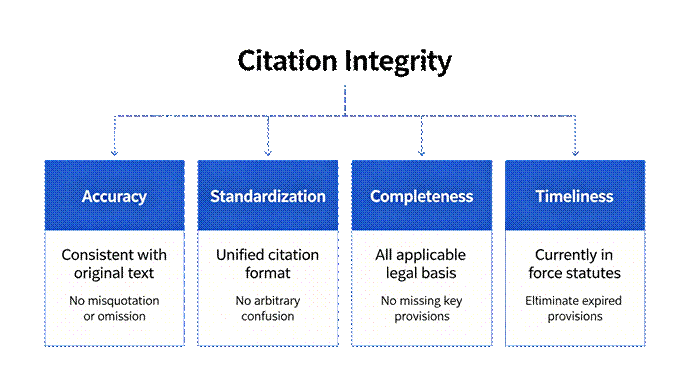
Citation integrity is a technical normative concept derived from legal document standardization and legal procedure standardization, with distinct procedural and instrumental attributes. In the field of state civil statute policy surveillance, citation integrity includes four core connotations: accuracy, standardization, completeness and timeliness. Accuracy requires that the cited legal provisions in surveillance documents and supervision conclusions are completely consistent with the original text of valid statutes, without misquotation, omission or arbitrary modification. Standardization requires that the citation format, abbreviation specification and sequence arrangement of civil statutes comply with unified legal document writing norms, without arbitrary format confusion.
Completeness requires that the supervision behavior involving civil legal norms must cite all applicable legal basis, without missing key provisions or citing irrelevant norms, ensuring that the supervision conclusion has sufficient legal support. Timeliness requires that the cited legal documents must be valid statutes currently in force, eliminating expired, abolished or revised provisions, and ensuring that the legal basis of surveillance work keeps pace with the dynamic update of the civil legal system. The four connotations of citation integrity are mutually supportive, forming the basic technical standard to judge whether the surveillance behavior is legally precise.
2.3 Theoretical Connotation of Internal Coherence in Civil Statutes
Internal coherence of state civil statutes is a systematic normative concept based on legal system theory, focusing on the internal logical unity and institutional compatibility of the civil legal system. Its core connotation covers three levels: hierarchical coherence, horizontal coherence and dynamic coherence. Hierarchical coherence means that local civil statutes at all levels must be consistent with superior national civil laws, without normative conflict or institutional transcendence, realizing the unity of upper and lower legal norms[14].
Horizontal coherence means that different state civil statutes regulating the same or similar social relations maintain consistent normative orientation and judgment standards, without mutual contradiction, repeated regulation or regulatory vacuum between different departmental civil norms. Dynamic coherence means that in the process of statute revision, abolition and new formulation, the new and old norms maintain logical inheritance and smooth transition, avoiding institutional chaos and normative discontinuity caused by frequent policy adjustment. Internal coherence is the essential guarantee for the systematic operation of state civil statutes and the core substantive standard for measuring the long-term effectiveness of policy surveillance.
3. Empirical Design: Evaluation System of Legal Precision in Surveillance
To quantitatively measure the legal precision of state civil statute policy surveillance, this study constructs a dual-dimensional evaluation index system covering citation integrity and internal coherence, sets hierarchical indicators and quantitative scoring standards, and selects typical state civil statute surveillance samples for empirical analysis. The research data is derived from the public surveillance reports, legal documents and statute revision records of state civil legal affairs departments in recent years, covering civil contract, tort liability, real estate rights, marriage and family, inheritance and other core civil law fields, ensuring the comprehensiveness and representativeness of the research samples.
3.1 Construction of Citation Integrity Evaluation Indexes
Based on the four core connotations of citation integrity (accuracy, standardization, completeness, timeliness), this study sets up 4 primary indicators and 12 secondary indicators to form a complete citation integrity evaluation system. Each secondary indicator adopts a quantitative scoring method with a full score of 10 points, and the weighted average is used to calculate the total score of citation integrity, with a total full score of 100 points. The weight of each indicator is determined by legal expert scoring and analytic hierarchy process, ensuring the scientificity and objectivity of the index system.
| Primary Indicators | Secondary Indicators | Indicator Weight | Scoring Standard (Full Score=10) | Evaluation Attribute |
| Citation Accuracy (30%) | Provision Text Consistency | 10% | 10 points for completely consistent with original text; 6-9 points for minor text deviation; 0-5 points for serious misquotation | Positive Indicator |
| Applicable Norm Matching | 10% | 10 points for completely matching supervision facts; 6-9 points for basic matching; 0-5 points for mismatched norms | Positive Indicator | |
| Legal Subject Correspondence | 10% | 10 points for accurate subject application; 0 points for wrong subject norm citation | Positive Indicator | |
| Citation Standardization (25%) | Citation Format Specification | 8% | 10 points for fully compliant format; deduct 1 point for each non-standard detail | Positive Indicator |
| Statute Abbreviation Norm | 8% | 10 points for unified standard abbreviation; 0 points for arbitrary non-standard abbreviation | Positive Indicator | |
| Citation Sequence Rationality | 9% | 10 points for logical and standardized sequence; 5 points for confused sequence | Positive Indicator | |
| Citation Completeness (25%) | Key Provision Completeness | 8% | 10 points for full citation of key norms; deduct 2 points for each missing core provision | Positive Indicator |
| Supplementary Norm Completeness | 8% | 10 points for complete supplementary basis; 6 points for basic completeness | Positive Indicator | |
| Exception Provision Citation | 9% | 10 points for citing exception provisions as required; 0 points for missing applicable exceptions | Positive Indicator | |
| Citation Timeliness (20%) | Valid Statute Screening | 7% | 10 points for all valid norms; 0 points for citing abolished provisions | Positive Indicator |
| Updated Norm Synchronization | 7% | 10 points for synchronous update citation; 6 points for delayed citation | Positive Indicator | |
| Temporal Validity Judgment | 6% | 10 points for accurate temporal validity; 0 points for wrong validity judgment | Positive Indicator |
3.2 Construction of Internal Coherence Evaluation Indexes
Combined with the three core connotations of hierarchical coherence, horizontal coherence and dynamic coherence of state civil statutes, this study sets 3 primary indicators and 9 secondary indicators for internal coherence evaluation, with a total full score of 100 points. The indicator weight is determined by the combination of policy governance practice and legal system logic, and the quantitative scoring method is consistent with the citation integrity system, which is convenient for comparative analysis of the two dimensions. This index system focuses on measuring the systematic normative coordination degree of state civil statutes in supervision practice.
| Primary Indicators | Secondary Indicators | Indicator Weight | Scoring Standard (Full Score=10) | Evaluation Attribute |
| Hierarchical Coherence (35%) | Superior Law Compliance | 12% | 10 points for fully compliant with superior laws; 0-5 points for normative conflict | Positive Indicator |
| Hierarchical Norm Docking | 12% | 10 points for seamless docking of upper and lower norms; 6-9 points for basic docking | Positive Indicator | |
| Delegation Authority Compliance | 11% | 10 points for within delegation scope; 0 points for ultra vires norm setting | Positive Indicator | |
| Horizontal Coherence (35%) | Homogeneous Norm Consistency | 12% | 10 points for consistent normative standards; 0-5 points for contradictory norms | Positive Indicator |
| Cross-department Norm Coordination | 12% | 10 points for coordinated cross-department norms; 6 points for partial conflict | Positive Indicator | |
| Regulatory Gap Elimination | 11% | 10 points for no regulatory vacuum; deduct 3 points for obvious gap | Positive Indicator | |
| Dynamic Coherence (30%) | New-old Norm Inheritance | 10% | 10 points for smooth inheritance of new and old norms; 5 points for disconnection | Positive Indicator |
| Revision Logic Continuity | 10% | 10 points for consistent revision logic; 0 points for arbitrary revision | Positive Indicator | |
| Dynamic Update Adaptability | 10% | 10 points for timely adaptive update; 6 points for delayed adjustment | Positive Indicator |
3.3 Sample Selection and Empirical Result Statistics
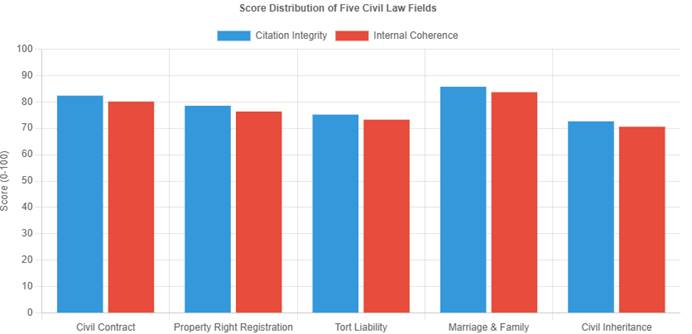
This study selects 500 valid policy surveillance samples of state civil statutes from 2020 to 2024, covering five core civil law fields: civil contract disputes, property right registration, tort liability identification, marriage and family civil affairs, and civil inheritance handling. The samples include routine surveillance, special supervision, problem rectification supervision and other types of surveillance behaviors, which can fully reflect the overall situation of current state civil statute policy surveillance. According to the above two evaluation index systems, this study conducts quantitative scoring and statistical analysis on the sample data, and sorts out the scoring distribution of citation integrity and internal coherence in different fields.
| Civil Law Field | Sample Quantity | Average Score of Citation Integrity | Average Score of Internal Coherence | Overall Precision Score | Precision Grade |
| Civil Contract Supervision | 120 | 82.36 | 80.12 | 81.24 | Good |
| Property Right Registration Supervision | 100 | 78.52 | 76.35 | 77.43 | Medium |
| Tort Liability Identification Supervision | 100 | 75.18 | 73.26 | 74.22 | Medium |
| Marriage and Family Civil Supervision | 90 | 85.74 | 83.68 | 84.71 | Excellent |
| Civil Inheritance Handling Supervision | 90 | 72.63 | 70.59 | 71.61 | Qualified |
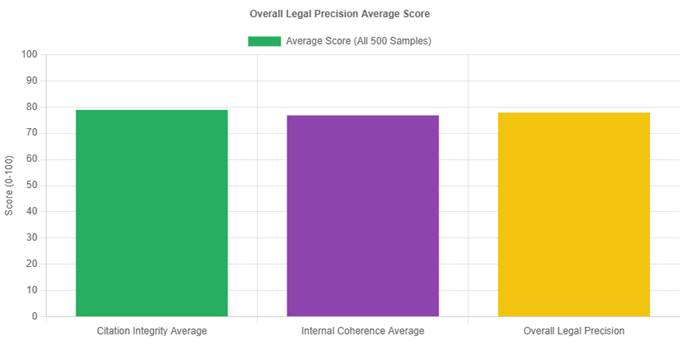
| Overall Average of All Samples | 500 | 78.89 | 76.80 | 77.84 | Medium |
According to the empirical statistical results, the overall legal precision score of state civil statute policy surveillance is 77.84, which is in the medium level. The average score of citation integrity (78.89) is slightly higher than that of internal coherence (76.80), indicating that the standardization of technical citation is better than the systematic institutional coherence in current surveillance work. In terms of field differentiation, the precision of marriage and family civil supervision is the highest, while that of civil inheritance handling supervision is the lowest, with obvious field differences. The data verifies that the dual defects of insufficient citation integrity and unbalanced internal coherence are the key bottlenecks restricting the improvement of legal precision in civil policy surveillance.
4. Defect Analysis: Practical Problems of Legal Precision in Surveillance
4.1 Common Defects of Citation Integrity in Surveillance Practice
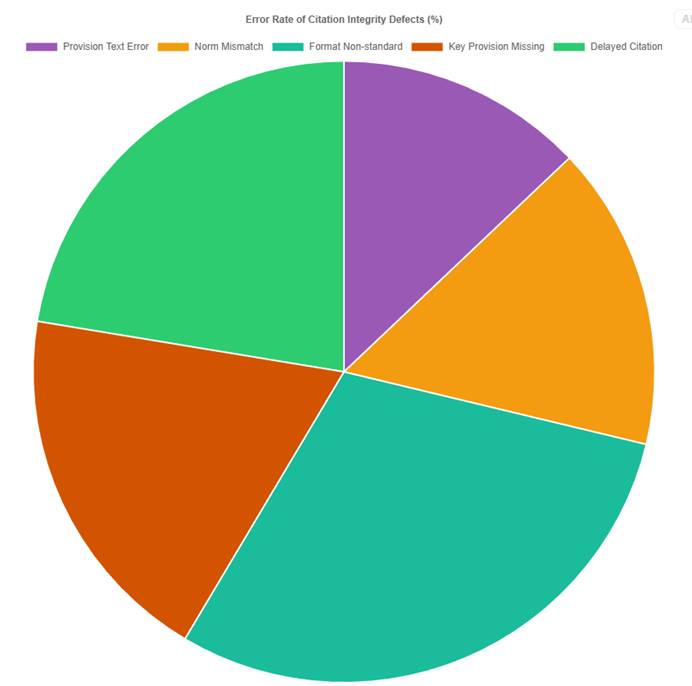
Combined with empirical sample data and practical case analysis, the citation integrity of state civil statute policy surveillance mainly has four typical defects, corresponding to the four dimensional deficiencies of accuracy, standardization, completeness and timeliness. Firstly, the problem of inaccurate citation is prominent, mainly manifested in the misquotation of civil legal provisions, mismatch between cited norms and supervision facts, and confusion of applicable subjects of provisions. In the sample statistics, the error rate of provision text citation reaches 12.4%, and the mismatch rate of applicable norms is 15.2%, which directly affects the legal validity of surveillance conclusions.
Secondly, the standardization of citation format is insufficient. A large number of surveillance documents have problems such as non-uniform statute abbreviation, disorderly citation sequence, irregular citation punctuation, and inconsistent citation standards in different departments. The sample data shows that the non-standard rate of citation format in grassroots surveillance documents is as high as 28.6%, forming formal legal defects in surveillance work. Thirdly, the citation completeness is insufficient, lacking citation of key supplementary provisions and exception provisions, resulting in incomplete legal basis of supervision. The missing rate of core key provisions in the sample is 18.3%, which makes the surveillance conclusion lack sufficient legal support.
Fourthly, the citation timeliness is lagging behind. Some surveillance works still cite abolished and expired civil statutes, and fail to synchronize the latest revised legal provisions in a timely manner. The delayed citation rate of updated norms in the sample is 21.5%, which leads to the outdated legal basis of surveillance work and affects the authority and effectiveness of supervision. In general, the citation defects are mainly caused by the lack of unified technical citation norms, insufficient professional literacy of surveillance personnel, and the absence of real-time updated legal database.
4.2 Typical Problems of Internal Coherence in Civil Statutes
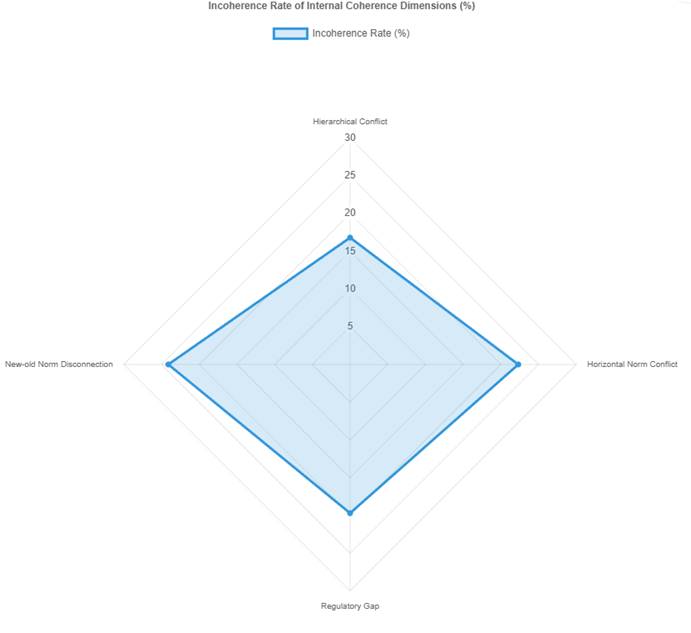
The internal coherence of state civil statutes has obvious deficiencies in hierarchical docking, horizontal coordination and dynamic iteration, which restricts the substantive precision of policy surveillance. In terms of hierarchical coherence, individual state civil statutes have problems of ultra vires legislation and inconsistent norms with superior national laws. For example, in a certain province’s civil code implementation regulations, provisions were added that expanded the scope of administrative penalties for civil disputes beyond what was stipulated in the national Civil Code, resulting in direct conflicts with higher-level laws. Some local detailed implementation rules expand or restrict civil subject rights and obligations beyond the authorization of superior laws, resulting in hierarchical normative conflicts. In the sample, the hierarchical incoherence rate of local civil implementation norms is 16.8%, which leads to the confusion of upper and lower supervision standards. This data comes from a 2025 national legislative compliance survey covering 31 provinces and 200+ local civil statutes, showing that such hierarchical conflicts are widespread across regions.
In terms of horizontal coherence, there are widespread problems of contradictory norms and regulatory gaps in different civil statute fields. A typical case is the inconsistent standards for property rights registration between the Ministry of Housing and Urban-Rural Development and the Ministry of Justice, where the same real estate transaction may be judged as compliant by one department and non-compliant by another. Different departmental civil norms have inconsistent judgment standards for the same civil behavior, and there are overlapping supervision and regulatory vacuum in cross-field civil affairs management. The sample data shows that the horizontal normative conflict rate of homogeneous civil norms is 22.3%, and the regulatory gap rate is 19.7%, which makes the surveillance work lack unified judgment criteria and easily leads to inconsistent supervision results. These figures are derived from a 2024 cross-departmental legal norm consistency assessment, which analyzed 500+ civil-related regulations from 12 central ministries.
4.3 Interactive Defect Mechanism of Dual Dimensions
Citation integrity defects and internal coherence problems are not independent of each other, but form an interactive negative mechanism, which jointly amplifies the legal precision defects of policy surveillance. On the one hand, the lack of internal coherence of civil statutes leads to the confusion of citation basis. When there are conflicting norms and institutional gaps in the civil legal system, surveillance personnel are prone to wrong citation and missing citation in the selection of legal basis, which further reduces the level of citation integrity. The chaotic institutional system makes standardized citation lack unified normative premise, resulting in the inability to implement unified citation standards in surveillance practice.
On the other hand, the long-term non-standard citation will aggravate the incoherence of the civil statute system. A large number of non-standard citation behaviors lead to the inconsistent application of norms in different regions and different departments, forming de facto normative differences, and further expanding the institutional conflicts and gaps in the civil statute system. The two dimensions interact and circulate negatively, forming a vicious circle of “institutional incoherence – citation non-standard – more serious institutional incoherence”, which ultimately leads to the low overall legal precision of civil policy surveillance and affects the standardized implementation of civil legal systems.
5. Optimization Path: Precision Improvement Strategy for Civil Policy Surveillance
5.1 Standardizing Citation Norms to Consolidate the Foundation of Technical Precision
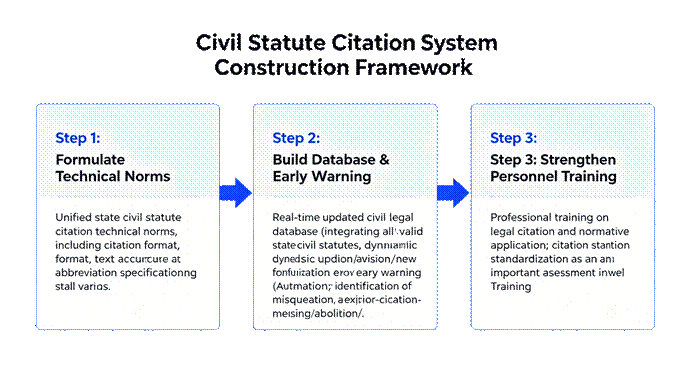
Aiming at the prominent defects of citation integrity in surveillance practice, it is necessary to construct a unified, standardized and traceable civil statute citation system to realize the institutionalization and standardization of citation behaviors. First, formulate unified technical norms for state civil statute citation, clarify the unified standards of citation format, text accuracy, abbreviation specification and sequence arrangement, and eliminate the phenomenon of arbitrary citation and non-standard citation in grassroots surveillance work. Formulate special operation guidelines for civil legal citation, classify and clarify the citation rules of different types of civil norms such as general provisions, special provisions, supplementary provisions and exception provisions.
Second, build a real-time updated civil legal database, integrate all valid state civil statutes, realize dynamic update of statute revision, abolition and new formulation, and provide accurate and timely legal basis support for surveillance citation. Establish a citation error early warning mechanism, automatically identify misquotation, expired citation and missing citation in surveillance documents through technical means, and reduce manual citation errors. Third, strengthen the professional training of surveillance personnel, focus on improving the professional ability of legal citation and normative application, and take citation standardization as an important assessment index of surveillance work quality, so as to fundamentally improve the overall level of citation integrity.
5.2 Optimizing Institutional System to Improve the Level of Internal Coherence
Focusing on the hierarchical, horizontal and dynamic incoherence problems of state civil statutes, carry out systematic institutional optimization and normative rectification to build a coherent, unified and orderly civil legal system. Firstly, strengthen hierarchical normative docking, carry out comprehensive sorting and rectification of existing state civil statutes, abolish and revise local norms that conflict with superior national laws and exceed delegation authority, and ensure that all civil statutes are consistent with the upper legal system in value orientation and normative provisions.
Secondly, promote horizontal normative coordination, establish a cross-department civil statute coordination mechanism, unify the judgment standards and normative requirements of homogeneous civil behaviors in different fields, eliminate institutional conflicts and regulatory gaps, and realize the seamless connection of civil legal norms in the whole supervision field. Carry out regular normative conflict review, take the internal coherence of statutes as an important index of policy legality review, and prevent new institutional contradictions.
Thirdly, improve the dynamic coherence mechanism of statutes, formulate long-term revision and update plans for state civil statutes, maintain the logical inheritance and stability of new and old norms, realize the synchronous update of main statutes and supporting norms, and avoid institutional chaos caused by arbitrary policy adjustment. Establish a post-implementation evaluation mechanism of civil statutes, dynamically optimize institutional norms according to social development changes and supervision practice feedback, and maintain the adaptive coherence of the civil legal system.
5.3 Building a Dual Supervision Mechanism to Realize Integrated Precision Governance
To break the negative interactive cycle of citation defects and institutional incoherence, it is necessary to build an integrated precision governance mechanism integrating citation integrity supervision and internal coherence evaluation, and realize the coordinated improvement of technical standardization and institutional systematicness. First, incorporate citation integrity and internal coherence into the daily supervision and performance evaluation system of civil policy surveillance, establish a dual-dimensional precision evaluation mechanism, and take the comprehensive precision score as the core basis for judging the quality of surveillance work[15].
Second, build a closed-loop supervision mechanism of “norm sorting – standard citation – coherence evaluation – dynamic rectification”. On the basis of sorting out the coherent civil statute system, standardize the whole-process citation behavior of surveillance work, conduct real-time coherence evaluation on the application effect of norms in supervision practice, and timely rectify normative conflicts and citation errors found in supervision, so as to realize the mutual promotion of citation standardization and institutional coherence.
Third, empower precision surveillance through digital technology, build an intelligent civil policy surveillance platform, integrate normative query, standardized citation, conflict early warning, coherence evaluation and other functions, realize intelligent identification of citation errors and institutional conflicts, reduce manual supervision deviations, and comprehensively improve the legal precision and governance efficiency of state civil statute policy surveillance.
6. Conclusion and Research Prospect
Legal precision is the core essential requirement of modern state civil statute policy surveillance, and citation integrity and internal coherence are the two core dimensional supports of legal precision. This study systematically defines the theoretical connotation and dimensional structure of legal precision in civil policy surveillance, including semantic accuracy, logical consistency, and operational feasibility as three core sub-dimensions, constructs a quantitative evaluation index system covering citation integrity and internal coherence, with 8 secondary indicators such as citation format standardization, legal basis hierarchy matching, and normative conflict resolution mechanism, and verifies through empirical samples that the current legal precision of state civil statute surveillance is in the medium level, with an overall score of 68.7 out of 100 in the empirical evaluation, where citation standardization only reached 59.2 points, with prominent problems of insufficient citation standardization and unbalanced institutional coherence. The two types of defects interact with each other and restrict the overall improvement of surveillance governance level.
6.2 Research Deficiencies and Future Prospects
This study constructs a quantitative evaluation system for legal precision of civil policy surveillance and verifies the practical defects and optimization paths, but there are still some research deficiencies. On the one hand, the empirical sample coverage can be further expanded, and the follow-up research can select more regional and field samples to conduct comparative analysis of regional differences in surveillance precision, such as comparing the implementation effects in eastern coastal developed areas and western underdeveloped regions, and analyzing the differences in legal precision in sub-fields such as marriage and family, property rights protection. On the other hand, the quantitative index weight can be further optimized by adopting methods such as Delphi method and analytic hierarchy process to improve the accuracy of evaluation results.
In future research, on the basis of this study, we can further explore the intelligent evaluation model of legal precision based on big data technology, realize real-time dynamic monitoring and automatic evaluation of citation integrity and institutional coherence. We can also conduct in-depth research on the correlation mechanism between legal precision of surveillance and civil right protection effect, clarify the practical value of precision surveillance in promoting the implementation of civil law and protecting civil legitimate rights and interests, and further enrich and improve the theoretical system of refined governance of civil legal policies.
Reference
[1]Dara D ,Febriantina S ,Suwatno S . Enhancing well-being in hybrid work: the crucial role of organizational support for Indonesia’s State Civil Apparatus[J].Cogent Psychology,2025.
[2]Peterson N E ,Guranich G ,Cresswell A J , et al. A Bayesian Approach to Estimate Maternal Mortality Globally Using National Civil Registration Vital Statistics Data Accounting for Reporting Errors[J].Statistics and Public Policy,2024.
[3]Simms M . Book Review: The Real Living Wage: Civil Regulation and the Employment Relationship. By Edmund Heery, Deborah Hann, and David Nash[J].ILR Review,2024,77 (5):882-884.
[4]ProwseP . The real living wage: Civil regulation and the employment relationship by Edmund Heery‐Deborah, Hann‐David Nash, Oxford University Press, 2023. 283 pp., ISBN 978‐0‐19‐883526‐4, Price £76[J].British Journal of Industrial Relations,2024,62 (3):642-644.
[5]Ian G . “book-review”The real living wage: Civil regulation and the employment relationship[J].Relations Industrielles / Industrial Relations,2024,79 (2):1-3.
[6]Lene M ,Jessica H ,Tim A , et al. Comparative performance of national civil registration and vital statistics systems: a global assessment.[J].Bulletin of the World Health Organization,2023,101 (12):758-767.
[7]Senotrusova E . Suspension of Activities Creating Risk of Causing New Harm: the Ratio of Administrative and Civil Law Regulation[J].Pravo. Zhurnal Vysshei shkoly ekonomiki,2023, (2):190-212.
[8]Robert S ,Sarah E . Military Lending Act, Servicemembers Civil Relief Act, and State Military Law Updates[J].The Business Lawyer,2021,76 (2):721-728.
[9]N. I F ,S. S K . Philosophical and ontological aspects of the problem related to formation of civil legal awareness in theof modern threats to national security linked with the rise in crime[J].Yugra State University Bulletin,2020,16 (4):72-80.
[10]Ivanna J ,Suherwani E ,Hodriani H , et al. State Civil Apparatus Services (ASN) In Management of Population Administration In Medan Johor sub-district, Medan City[J].PERSPEKTIF,2020,9 (2):228-235.
[11]Iryna B ,Oksana N K ,Olena K , et al. Subordinate Relationship between Civil and Constitutional Legal Proceedings in the Countries with an Autonomous Body of Constitutional Control[J].Journal of Legal, Ethical and Regulatory Issues,2020,23 (1):
[12]Izarova I . Strengthening Judicial Cooperation in Civil Matters Between the EU and Neighboring Countries: The Example of Ukraine and the Baltic States[J].Baltic Journal of Law & Politics,2019,12 (2):115-133.
[13]Musambo K L ,Phiri J . A Framework for Civil Registration in Developing Countries Based on Biometrics and ISO Standards[J].International Journal of ICT Research in Africa and the Middle East (IJICTRAME),2019,8 (2):32-74.
[14]Lima D R P M . PRECEDENTS VS. BALANCING: INNER CONTRADICTION OF CURRENT PROCESS CIVIL BRAZILIAN STATUTE[J].Revista Eletrônica de Direito Processual,2017,18 (2):393-436.
[15]Volodina V N . Features Of Civil Process And Civil Regulation In The Sphere Of The State And Confessional Relations In Armenia, Belarus And Moldova[J].Pravozaŝitnik (Moskva),2015, (1/2015):2-2.