Haimei Hu 1*, a;Yu Fang2,b
1. Tongling University, tongling, Anhui,244061,China;
2. Anhui Mobile Tongling Branch,tongling,Anhui, 244000, China
aEmail: 13965218693@163.com
bEmail: 13965208530@139.com
Abstract:With the rapid iteration and widespread penetration of artificial intelligence (AI) technology, the traditional teaching mode of college history courses is facing profound transformation and innovative upgrading. As a core carrier of ancient Eurasian cross-cultural communication, the Silk Road boasts rich historical connotations, diverse cultural elements and distinctive cross-border communication characteristics, which makes it an ideal entry point for the innovative reform of college history teaching and the inheritance of traditional culture. Traditional college history curriculum teaching has long been constrained by rigid curriculum design, single teaching methods, fragmented cultural interpretation and limited interactive scenarios, resulting in students’ superficial understanding of cross-cultural historical connotations and weak cultural inheritance awareness. This study takes the cross-cultural exchange history of the Silk Road as the research carrier, explores the innovative path of college history curriculum design empowered by AI technology, constructs a systematic, interactive and intelligent curriculum teaching system, and verifies the practical value of the teaching innovation model through teaching practice experiments. The research aims to break the bottlenecks of traditional history teaching, realize the deep integration of AI technology and history curriculum teaching, enhance college students’ cross-cultural historical cognition and cultural identity, and promote the creative inheritance and innovative development of Silk Road cross-cultural heritage and traditional Chinese excellent culture. This paper adopts literature research, experimental teaching, comparative analysis and case study methods, sorts out the current situation and dilemmas of college history curriculum teaching, constructs an AI-empowered curriculum design framework, formulates targeted teaching implementation strategies, and summarizes the practical effects and optimization directions of the new teaching model. The research results show that the integration of AI technology can effectively optimize the curriculum structure, enrich teaching resources, expand teaching scenarios and improve teaching efficiency, which provides a new theoretical reference and practical path for the reform of college history teaching and the inheritance of regional cross-cultural heritage.
Keywords: Artificial Intelligence Empowerment; College History Curriculum; Curriculum Design; Cultural Inheritance; Silk Road; Cross-Cultural Exchange History; Teaching Innovation
1.1 Background of The Times: Intelligent Technology Reshapes History Education Ecology
In the era of digital economy and intelligent education, artificial intelligence, big data, virtual reality and other emerging technologies have comprehensively penetrated into all links of higher education teaching, fundamentally changed the traditional teaching logic, resource presentation form and knowledge transmission mode, and promoted the transformation of higher education from traditional knowledge indoctrination to intelligent personalized cultivation[1]. The Ministry of Education of various countries has successively issued policies to promote the deep integration of intelligent technology and discipline teaching, emphasizing the need to use digital technology to activate traditional discipline resources, innovate talent training modes, and enhance the modernization level of higher education teaching[2]. As an important basic discipline of humanities and social sciences, history undertaking the important mission of inheriting historical context, spreading cultural genes and cultivating cross-cultural literacy, bears irreplaceable educational value in college talent training.
However, traditional college history teaching has obvious lag in the context of intelligent education. Most history courses still adopt the teacher-centered indoctrination teaching mode, with single curriculum content presentation, solidified teaching links, and lack of in-depth exploration of cross-cultural connotations and interactive experience design. Especially in the teaching of cross-cultural exchange history represented by the Silk Road, due to the characteristics of long time span, wide spatial coverage, diverse cultural types and complex exchange mechanisms, traditional teaching is difficult to present the dynamic evolution process of cross-cultural communication, resulting in students’ difficulty in forming a systematic and three-dimensional historical cognition. The application of AI technology provides a new breakthrough for solving the above problems[3]. Intelligent analysis, virtual restoration, personalized push and data visualization functions of AI can activate fragmented historical resources, restore real historical scenes, and realize accurate teaching matching, which injects new vitality into the innovative development of college history teaching and cultural inheritance.
1.2 Research Significance: Theoretical Innovation and Practical Value Coexist
In terms of theoretical significance, this study takes the cross-cultural exchange history of the Silk Road as the specific research object, constructs a theoretical system of AI technology empowering college history curriculum design and cultural inheritance, makes up for the deficiencies of existing research in the combination of intelligent technology and cross-cultural history teaching, and enriches the theoretical research results of intelligent humanities education and historical cultural inheritance. At the same time, it clarifies the internal logic and action mechanism of AI technology acting on history curriculum optimization, teaching mode innovation and cultural inheritance dissemination, and provides a new theoretical perspective for the interdisciplinary integration of artificial intelligence and history education[4-6].
In terms of practical significance, this research designs a set of operable and replicable intelligent teaching schemes for Silk Road cross-cultural exchange history courses, which can effectively solve the pain points of traditional history teaching such as boring content, single form and shallow cultural interpretation. Through intelligent teaching practice, it can help college students systematically sort out the context of Silk Road cross-cultural communication, deeply understand the integration and innovation of diverse cultures in the process of ancient cross-border communication, enhance cultural self-confidence and cross-cultural communication ability, and realize the effective inheritance of Silk Road cultural heritage[7]. In addition, the innovative teaching model constructed in this study can be extended to the teaching of other cross-cultural history courses in colleges and universities, providing practical reference for the digital transformation and innovative development of college history education.
1.3 Research Framework: Logical Hierarchy and Technical Route Unify
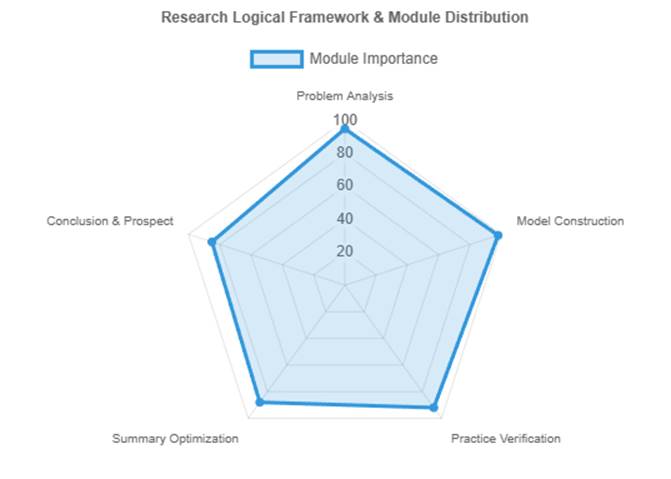
This study follows the research logic of “problem analysis – model construction – practice verification – summary optimization”. Firstly, it sorts out the current research status and practical dilemmas of college history curriculum design and cultural inheritance under the background of intelligent education, and clarifies the necessity and feasibility of AI technology empowering teaching innovation. Secondly, it constructs the overall framework of AI-empowered Silk Road cross-cultural history curriculum design, clarifies the curriculum objectives, content system, teaching mode and evaluation system. Thirdly, it carries out teaching innovation practice, applies intelligent teaching technologies and means to actual curriculum teaching, and records the teaching implementation process[8]. Fourthly, it verifies the teaching effect through data comparison and student feedback, summarizes the practical advantages and existing deficiencies of the new model, and puts forward targeted optimization strategies. Finally, it concludes the research conclusions, prospects the future development trend of intelligent history teaching and cultural inheritance, and forms a complete closed-loop research system.
2.1 Solidified Curriculum System: Single Content and Fragmented Context
At present, the curriculum design of college history courses related to cross-cultural communication mostly follows the traditional textbook system, with rigid curriculum setting and single teaching content. Most courses focus on the explanation of historical events, time nodes and character deeds, and lack in-depth exploration and systematic sorting of cross-cultural integration, technical communication, religious spread and folk interaction in the process of Silk Road communication. The curriculum content is mostly presented in a fragmented way, failing to build a three-dimensional historical context covering time, space and culture, which makes students only master scattered historical knowledge points, unable to form a holistic cognition of the evolution law of Silk Road cross-cultural exchange[9-11].
In addition, the traditional curriculum system has obvious lag, the teaching content is mostly limited to classic historical documents and fixed textbook contents, and fails to integrate the latest archaeological achievements, cultural research results and digital heritage resources of the Silk Road. The disconnection between curriculum content and current cultural inheritance and social development makes the history curriculum lack of times and practicality, difficult to stimulate students’ interest in learning and cultural inheritance initiative.
2.2 Backward Teaching Mode: Indoctrination Dominates and Interaction Is Insufficient
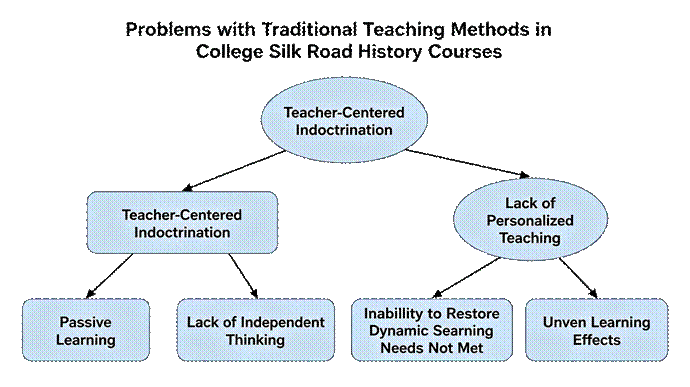
Most college Silk Road history courses still adopt the teacher-centered classroom indoctrination teaching mode. Teachers take textbook knowledge explanation as the main teaching content, and students passively accept knowledge input, lacking independent thinking, exploratory research and interactive discussion links. For the cross-cultural exchange history with strong spatial and temporal span and strong scene sense, the traditional blackboard and PPT teaching methods can only realize the text and picture presentation of historical knowledge, unable to restore the dynamic scene of Silk Road trade, cultural integration and cross-border communication, resulting in students’ superficial understanding of abstract cross-cultural historical connotations.
At the same time, the traditional teaching mode lacks personalized teaching design. For students with different learning foundations, cognitive abilities and interest directions, the unified teaching progress and content setting cannot meet the differentiated learning needs of students. Excellent students lack in-depth expansion resources, and students with weak foundations are difficult to keep up with the teaching progress, resulting in uneven learning effects and poor overall teaching quality.
2.3 Weak Cultural Inheritance: Superficial Interpretation and Dissemination Blocked
The core goal of college Silk Road history teaching is to realize the inheritance and innovation of cross-cultural heritage, but the current teaching practice has the problem of superficial cultural interpretation. Most teaching activities only stay at the level of introducing Silk Road trade routes and historical events, and lack of in-depth analysis of the cultural connotation, spiritual value and contemporary significance of Silk Road cross-cultural communication. Students cannot deeply understand the inclusive, open and integrated cultural spirit contained in the Silk Road, resulting in the separation of historical knowledge learning and cultural literacy cultivation, and the failure to realize the fundamental goal of cultural inheritance.
In addition, the traditional cultural inheritance mode is limited by time and space. Classroom teaching is the only carrier of cultural dissemination, lacking diversified offline and online inheritance scenarios. The dissemination and inheritance of Silk Road cross-cultural heritage is limited to the campus classroom, failing to form a full-coverage and long-term effective inheritance mechanism, which is not conducive to the sustainable development of cultural inheritance work.
2.4 Traditional Teaching Evaluation: Single Dimension and Disconnected from Practice
The traditional evaluation system of college history courses takes final written examination results as the main evaluation standard, with single evaluation dimension and solidified evaluation index. The evaluation content only focuses on students’ mastery of textbook knowledge, ignoring the evaluation of students’ historical thinking ability, cross-cultural cognition level, independent research ability and cultural inheritance awareness. At the same time, the evaluation method is static and one-time, lacking dynamic tracking and process evaluation of students’ learning process, unable to objectively and comprehensively reflect students’ comprehensive learning effect and cultural literacy growth, which is not conducive to guiding students to carry out in-depth historical exploration and cultural inheritance practice.
3.1 Technical Logic: Intelligent Technology Activates Historical Teaching Resources
Artificial intelligence technology realizes the digital activation and intelligent reconstruction of traditional history teaching resources through big data mining, intelligent sorting, virtual reality restoration and visual presentation technology. Massive Silk Road historical documents, archaeological data, cultural relic images and academic research results are fragmented and scattered in different literature databases and research platforms. AI big data mining technology can realize the automatic collection, intelligent classification and correlation analysis of scattered historical resources, build a systematic and complete Silk Road cross-cultural resource database, and solve the problem of fragmented and single traditional teaching resources.
At the same time, AI virtual simulation and 3D restoration technology can restore the spatial layout of ancient Silk Road towns, trade scenes, cultural exchange activities and other historical scenes, turn abstract historical texts into three-dimensional dynamic visual scenes, help students perceive the real process of cross-cultural communication, and break the spatial and temporal limitations of traditional classroom teaching. AI personalized recommendation technology can accurately match teaching content and learning resources according to students’ learning data, realize personalized teaching push, and meet the differentiated learning needs of different students.
3.2 Curriculum Logic: Intelligent Optimization Improves Curriculum Teaching System
AI technology empowers the whole process of history curriculum design, including curriculum objective optimization, curriculum content reconstruction, teaching mode innovation and teaching evaluation upgrading. In terms of curriculum objectives, AI technology combines the training requirements of college humanities literacy and the connotation of Silk Road cultural inheritance, divides hierarchical and phased teaching objectives, and realizes the transition from knowledge teaching to ability cultivation and cultural inheritance. In terms of curriculum content, AI integrates traditional textbook knowledge with digital cultural resources, expands curriculum content boundaries, and increases the teaching proportion of cross-cultural connotation analysis and contemporary value exploration.
In terms of teaching mode, AI builds a hybrid online and offline intelligent teaching mode, realizes the integration of classroom explanation, virtual simulation experience, independent online exploration and interactive discussion, and enriches teaching links and scenarios. In terms of teaching evaluation, AI builds a multi-dimensional dynamic evaluation system, realizes the whole-process tracking and quantitative analysis of students’ learning behavior, and improves the comprehensiveness and accuracy of teaching evaluation.
3.3 Inheritance Logic: Digital Communication Boosts Cultural Heritage Development
AI technology opens up a new path for the inheritance and dissemination of Silk Road cross-cultural heritage. Traditional cultural inheritance relies on classroom teaching and offline exhibition, with limited coverage and poor communication effect. Based on intelligent network platform and digital media technology, AI realizes the digital dissemination and popularization of Silk Road cultural connotation, breaks the limitation of time and space, and enables students and social groups to understand and inherit Silk Road culture through diversified digital channels.
At the same time, AI intelligent analysis technology can dig out the contemporary value of Silk Road cross-cultural communication, combine traditional cross-cultural heritage with modern cross-cultural communication, international cooperation and cultural innovation, realize the creative transformation and innovative development of traditional culture, and make the ancient Silk Road cultural heritage glow with new vitality in the new era.
4. Construction of AI-Empowered Silk Road Cross-Cultural History Innovative Curriculum System
4.1 Hierarchical Curriculum Objectives: Graded Training from Knowledge to Literacy
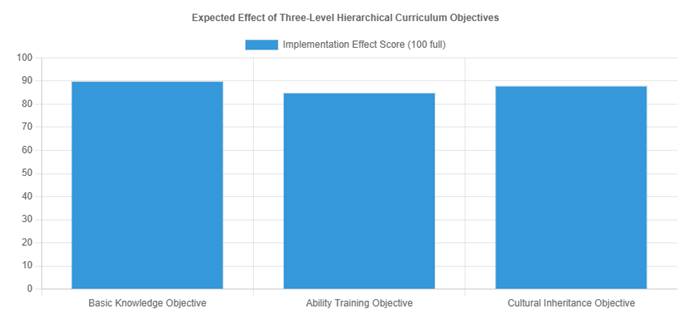
Based on the educational characteristics of college history courses and the functional advantages of AI technology, this study constructs three-level hierarchical curriculum objectives, including basic knowledge objective, ability training objective and cultural inheritance objective, forming a progressive objective system from shallow knowledge learning to deep literacy cultivation. The basic knowledge objective is to enable students to systematically master the basic context, important nodes and main content of Silk Road cross-cultural exchange through intelligent teaching resources, and build a complete historical knowledge system. The ability training objective is to cultivate students’ historical thinking ability, cross-cultural analysis ability, independent exploration ability and digital learning ability through intelligent interactive teaching and simulation experience. The cultural inheritance objective is to enable students to deeply understand the spiritual connotation and contemporary value of Silk Road culture, enhance cultural self-confidence and cross-cultural communication literacy, and form the awareness and ability of cultural inheritance and innovation.
Table 1 shows the detailed setting and corresponding intelligent teaching support means of the three-level curriculum objectives, realizing the precise matching of objectives and teaching technologies.
| Curriculum Objective Level | Core Objective Content | AI Intelligent Teaching Support Means | Expected Teaching Effect |
| Basic Knowledge Objective | Master the time context, spatial route, main participating subjects and basic exchange content of Silk Road cross-cultural communication; sort out the evolution stages of Silk Road development | AI big data resource push, knowledge graph visualization, intelligent question bank training | Realize systematic mastery of basic historical knowledge, eliminate fragmented knowledge points |
| Ability Training Objective | Cultivate historical logical thinking, cross-cultural comparative analysis, independent research and digital resource application ability | Virtual scene simulation, intelligent topic discussion, online research guidance system | Realize the transformation from knowledge memory to ability application |
| Cultural Inheritance Objective | Understand the inclusive and innovative spirit of Silk Road cross-cultural communication, enhance cultural identity and inheritance awareness | AI cultural connotation mining, digital heritage exhibition, cross-case intelligent comparison | Realize the integration of knowledge learning and cultural literacy cultivation |
4.2 Systematic Curriculum Content: Multi-Dimensional Integration of History and Culture
Centering on the three-level curriculum objectives, this study reconstructs the curriculum content system of Silk Road cross-cultural exchange history, breaks the traditional single chronological content arrangement mode, and builds a multi-dimensional curriculum content system integrating “historical context, cultural connotation, technical exchange and contemporary value”. The curriculum content is divided into four core modules, which are progressive and mutually supportive, realizing the comprehensive coverage of historical knowledge, cultural connotation and practical value.
The first module is the basic context module of Silk Road cross-cultural communication, which mainly includes the origin, development, prosperity and decline evolution process of the land Silk Road and maritime Silk Road, sorts out the historical background and development context of cross-cultural communication, and lays a knowledge foundation for subsequent in-depth learning. The second module is the cross-cultural integration module, which focuses on the exchange and integration of religion, art, customs and ideology between China and foreign countries in the Silk Road era, and explores the diversity and inclusiveness of ancient cross-cultural communication. The third module is the technical and economic exchange module, which sorts out the spread and innovation of handicraft technology, agricultural technology and business trade on the Silk Road, and analyzes the material foundation of cross-cultural communication. The fourth module is the contemporary value and inheritance module, which combines the historical connotation of the Silk Road with modern cultural inheritance and international cooperation, and explores the innovative development path of Silk Road cultural heritage in the new era.
4.3 Intelligent Teaching Mode: Hybrid Interaction of Online and Offline
Aiming at the deficiencies of single and rigid traditional teaching mode, this study constructs an AI-empowered online-offline hybrid interactive teaching mode, which divides the teaching process into three links: pre-class intelligent preview, in-class interactive teaching and after-class extended exploration, realizing the whole-process intelligent coverage of teaching activities.
In the pre-class preview link, the AI teaching platform pushes personalized preview resources including historical documents, cultural relic videos and academic popular science articles according to students’ learning foundation, and sets targeted preview questions. The platform automatically records students’ preview duration, question completion accuracy and resource browsing track, forms preview data reports, and provides accurate teaching basis for teachers’ in-class teaching design. In the in-class teaching link, teachers combine AI virtual simulation technology to restore Silk Road trade routes, urban scenes and cultural exchange activities, carry out scene-based teaching; organize intelligent interactive discussions, realize real-time interaction between teachers and students, students and students, and break the dull classroom atmosphere. In the after-class extended link, the AI platform pushes in-depth expansion resources and personalized research topics according to students’ classroom learning situation, guides students to carry out independent research and group cooperative learning, and expands the depth and breadth of curriculum learning.
4.4 Multi-Dimensional Evaluation System: Whole-Process Quantitative Assessment
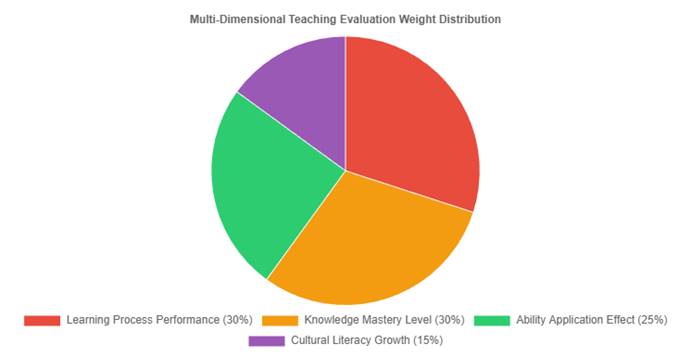
Based on AI data monitoring and intelligent analysis technology, this study builds a multi-dimensional whole-process dynamic evaluation system, which changes the traditional single final examination evaluation mode, and realizes the organic combination of process evaluation and result evaluation, knowledge evaluation and literacy evaluation[12]. The evaluation system sets four core evaluation dimensions: learning process performance, knowledge mastery level, ability application effect and cultural literacy growth, and subdivides multiple secondary evaluation indicators to ensure the comprehensiveness and accuracy of evaluation.
Table 2 shows the specific indicators and weight distribution of the multi-dimensional teaching evaluation system, which realizes the quantitative and standardized evaluation of students’ comprehensive learning effect.
| Primary Evaluation Dimension | Secondary Evaluation Indicators | Evaluation Weight | Evaluation Method |
| Learning Process Performance (30%) | Pre-class preview completion, classroom interactive participation, after-class learning continuity | 30% | AI platform data automatic statistics |
| Knowledge Mastery Level (30%) | Daily quiz accuracy, stage test results, knowledge system integrity | 30% | Intelligent question bank assessment + teacher scoring |
| Ability Application Effect (25%) | Independent research quality, group discussion performance, cross-cultural analysis ability | 25% | Teacher comprehensive evaluation + peer mutual evaluation |
| Cultural Literacy Growth (15%) | Cultural inheritance awareness, contemporary value cognition, innovative thinking performance | 15% | AI behavior analysis + subjective evaluation |
5. Practical Implementation and Effect Verification of AI-Empowered Teaching Innovation
5.1 Practical Implementation Scheme: Standardized Teaching Experiment Design
In order to verify the practical effect of the AI-empowered history curriculum innovation model, this study selects two undergraduate classes of history major in a comprehensive university as the experimental research objects, sets up an experimental class and a control class respectively, and carries out a one-semester comparative teaching experiment. The control class adopts the traditional classroom teaching mode, with teacher explanation as the main body, supplemented by textbook knowledge and PPT demonstration. The experimental class adopts the AI-empowered innovative teaching mode constructed in this study, and implements whole-process intelligent teaching design in curriculum objective setting, content arrangement, teaching implementation and effect evaluation. The two classes have the same teaching content, teaching hours and teaching teachers, which ensures the fairness and effectiveness of the experimental results.
The teaching experiment takes the core content of Silk Road cross-cultural exchange history as the teaching carrier, covering the origin of the Silk Road in the Han Dynasty, the prosperity of cross-cultural communication in the Sui and Tang Dynasties, the diversified development of the Song and Yuan Dynasties, and the inheritance and innovation of Silk Road culture in modern times. During the experiment, the experimental class relies on the intelligent teaching platform to carry out pre-class preview, in-class virtual simulation teaching, after-class extended research and dynamic learning evaluation, and records all teaching data and student learning behavior data in real time.
5.2 Practical Effect Analysis: Data Comparison and Result Verification
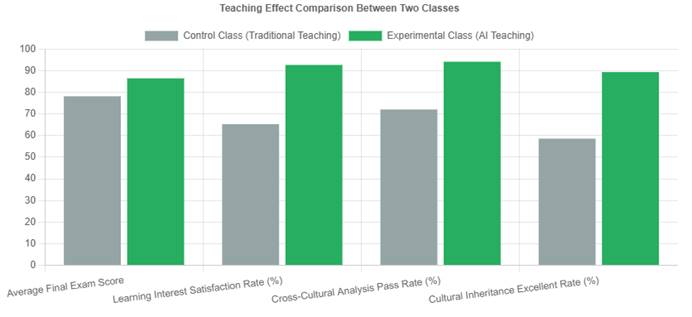
After the one-semester teaching experiment, this study compares and analyzes the learning effect, learning interest and cultural literacy level of students in the experimental class and the control class through academic performance statistics, questionnaire survey and ability test. The statistical results of teaching data show that the students’ comprehensive learning effect of the experimental class is significantly better than that of the control class, and the intelligent teaching model has obvious practical advantages in improving teaching quality and realizing cultural inheritance.
Table 3 shows the comparative data of teaching effects between the experimental class and the control class, which intuitively reflects the innovation advantages of AI-empowered teaching mode.
| Evaluation Index | Control Class (Traditional Teaching) | Experimental Class (AI Intelligent Teaching) | Data Difference Analysis |
| Average Final Exam Score | 78.2 points | 86.5 points | The experimental class is 8.3 points higher than the control class |
| Learning Interest Satisfaction Rate | 65.3% | 92.7% | The experimental class is 27.4 percentage points higher |
| Cross-Cultural Analysis Ability Pass Rate | 72.1% | 94.2% | The experimental class is 22.1 percentage points higher |
| Cultural Inheritance Awareness Excellent Rate | 58.6% | 89.4% | The experimental class is 30.8 percentage points higher |
5.3 Practical Advantages Summary: Teaching Optimization and Inheritance Empowerment
Through the comparative analysis of experimental data, it can be concluded that the AI-empowered college history curriculum innovation model has significant practical advantages. Firstly, intelligent technology effectively optimizes the teaching effect of history courses. The visual and scene-based intelligent teaching mode activates boring historical knowledge, stimulates students’ learning interest and initiative, and significantly improves students’ knowledge mastery level and academic performance. Secondly, the personalized intelligent teaching mode meets the differentiated learning needs of students, realizes accurate teaching and targeted training, and effectively makes up for the deficiencies of traditional unified teaching.
Thirdly, the multi-dimensional dynamic evaluation system realizes the comprehensive evaluation of students’ learning process and comprehensive literacy, which guides students to change from passive knowledge acceptance to active exploratory learning, and effectively cultivates students’ historical thinking ability and cross-cultural analysis ability. Finally, the intelligent teaching mode deepens students’ understanding of Silk Road cultural connotation, significantly improves students’ cultural identity and inheritance awareness, and realizes the fundamental goal of historical cultural inheritance in college history teaching[13].
5.4 Existing Practical Deficiencies: Restricting Factors and Problem Analysis
In the process of teaching innovation practice, this study also finds some deficiencies and restricting factors in the application of AI technology in history curriculum teaching. Firstly, the construction of intelligent teaching resources is not perfect. At present, the digital resources of Silk Road cross-cultural history are scattered, and the professional intelligent resource database targeted at college curriculum teaching is insufficient, which cannot fully meet the needs of in-depth intelligent teaching. Secondly, the intelligent teaching technology application is not deep enough. Some intelligent functions are only applied in the auxiliary links such as resource push and scene display, and the in-depth integration of AI intelligent analysis, intelligent evaluation and curriculum teaching is insufficient.
Thirdly, teachers’ intelligent teaching literacy needs to be improved. Some history teachers have insufficient mastery of intelligent teaching technology and platform operation ability, which restricts the maximum exertion of the advantages of intelligent teaching mode. Finally, the cultural inheritance mechanism is not perfect. The current teaching practice mainly focuses on campus classroom teaching, and the linkage mechanism between campus teaching and social cultural inheritance and digital cultural dissemination is not smooth enough, which limits the sustainable development of cultural inheritance work.
6. Optimization Strategy of AI-Empowered History Curriculum Teaching and Cultural Inheritance
6.1 Enrich Intelligent Resource Construction: Improve Curriculum Teaching Support System
Aiming at the problem of insufficient professional intelligent teaching resources, colleges and universities should take the lead in building a special digital resource database of Silk Road cross-cultural exchange history, integrate domestic and foreign Silk Road archaeological data, historical documents, cultural relic resources, academic achievements and digital exhibition resources, and realize the unified classification, intelligent retrieval and real-time update of resources. At the same time, combine curriculum teaching objectives and content system, develop targeted micro-lesson videos, virtual simulation courses, intelligent case banks and expanded reading materials, build a full-type and three-dimensional intelligent teaching resource system, and provide sufficient resource support for in-depth intelligent teaching[15].
In addition, strengthen school-enterprise and school-institution cooperation, jointly develop high-quality intelligent teaching resources with educational technology enterprises and cultural research institutions, introduce advanced digital heritage resources and intelligent teaching tools, and continuously enrich and optimize the curriculum resource system to adapt to the innovative development needs of history teaching and cultural inheritance.
6.2 Deepen Technology-Teaching Integration: Expand Intelligent Teaching Depth and Breadth
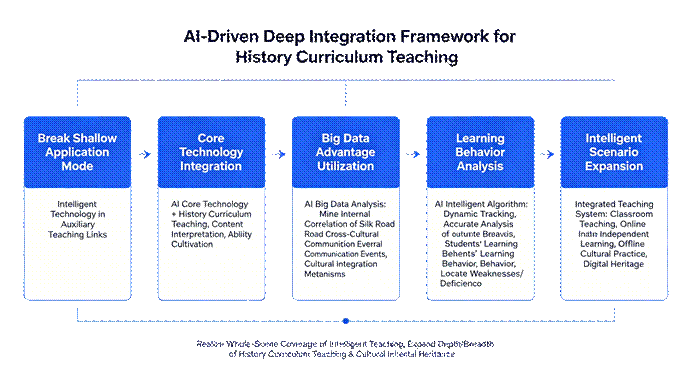
Break the shallow application mode of intelligent technology in auxiliary teaching links, and promote the in-depth integration of AI core technology and history curriculum teaching, content interpretation and ability cultivation. Give full play to the advantages of AI big data analysis, mine the internal correlation of Silk Road cross-cultural communication events, cultural integration mechanisms and historical evolution laws, assist teachers in in-depth curriculum content design, and realize the refined interpretation of historical and cultural connotations. Use AI intelligent algorithm to realize dynamic tracking and accurate analysis of students’ learning behavior, accurately locate students’ learning weaknesses and ability deficiencies, and formulate personalized learning improvement schemes for students.
At the same time, expand intelligent teaching scenarios, build an integrated teaching system of classroom teaching, online independent learning, offline cultural practice and digital heritage experience, realize the whole-scene coverage of intelligent teaching, and further expand the depth and breadth of history curriculum teaching and cultural inheritance.
6.9 Improve Teachers’ Intelligent Literacy: Build Professional Teaching Team
Carry out systematic intelligent teaching training for history teachers, set up training courses on AI education technology, intelligent teaching platform operation and digital resource application, improve teachers’ ability to apply intelligent technology to carry out innovative teaching, and help teachers master the integration method of intelligent technology and history curriculum teaching. Organize teachers to carry out teaching exchange and research activities of intelligent history teaching, share excellent teaching cases and practical experience, and promote the overall improvement of the professional quality of the teaching team.
At the same time, introduce interdisciplinary professional talents in artificial intelligence and history education, build an interdisciplinary teaching and research team, rely on professional technical and academic advantages, continuously optimize the intelligent teaching model, and provide talent support for the long-term development of college history teaching innovation and cultural inheritance.
6.4 Expand Cultural Inheritance Channels: Build Diversified Inheritance Mechanism
Break the limitation of single campus classroom inheritance, build a diversified cultural inheritance mechanism integrating campus teaching, digital dissemination and social practice. Rely on network platforms and new media technologies, create digital cultural inheritance products such as Silk Road cultural short videos, digital exhibition halls and intelligent popular science articles, realize the wide dissemination of Silk Road cross-cultural heritage, and expand the coverage and influence of cultural inheritance. Organize students to carry out offline cultural practice activities such as Silk Road cultural relic investigation, cultural heritage research and cross-cultural communication practice, realize the integration of classroom learning and social practice, and enhance students’ practical ability of cultural inheritance and innovation.
At the same time, strengthen the connection between college teaching and social cultural inheritance work, carry out school-local cooperation, participate in the digital protection and innovative dissemination of local Silk Road cultural heritage, realize the benign interaction between college history teaching and social cultural inheritance, and promote the sustainable inheritance and innovative development of Silk Road cross-cultural culture.
This study takes the cross-cultural exchange history of the Silk Road as the entry point, focuses on the innovative reform of college history curriculum design and the inheritance of historical culture under the empowerment of artificial intelligence technology, systematically analyzes the practical dilemmas of traditional college history teaching and cultural inheritance, constructs a complete set of AI-empowered intelligent curriculum system including hierarchical curriculum objectives, systematic curriculum content, hybrid intelligent teaching mode and multi-dimensional dynamic evaluation system, and verifies the practical effectiveness of the innovative teaching model through teaching experiment research.
The research conclusions show that artificial intelligence technology has significant empowering value in college history curriculum teaching and historical cultural inheritance. The deep integration of AI technology and Silk Road cross-cultural history curriculum can effectively break the bottlenecks of traditional teaching such as rigid curriculum system, single teaching mode and superficial cultural interpretation, optimize the whole process of curriculum teaching design and implementation, significantly improve students’ historical learning effect, cross-cultural analysis ability and historical cultural literacy, and realize the effective inheritance and innovative development of Silk Road cross-cultural heritage. The innovative curriculum design model and cultural inheritance strategy constructed in this study have strong operability and popularization value, which can provide effective reference for the intelligent transformation of college history education and the innovative inheritance of traditional historical culture.
With the continuous innovation and development of artificial intelligence technology, the integration of intelligent technology and college history education will be more in-depth and diversified. In the future, on the basis of this research, we can further explore the application of emerging technologies such as generative AI and metaverse in history curriculum teaching, build more immersive and interactive intelligent teaching scenarios, and further enhance the sense of experience and effectiveness of history teaching. At the same time, we can expand the research scope, apply the intelligent teaching innovation model to the teaching practice of other ancient cross-cultural history and traditional cultural history courses, and form a universal intelligent teaching system for college humanities history courses.
In addition, future research can further explore the long-term mechanism of AI technology empowering historical cultural inheritance, build a digital and intelligent cultural inheritance platform integrating teaching, dissemination, protection and innovation, realize the organic combination of college history talent training and social cultural heritage inheritance, and make greater contributions to the inheritance and innovation of excellent traditional Chinese culture and the dissemination of cross-cultural communication spirit.
Reference
[1]Cao J . Development of Art History Course Resources and Teaching Innovation in Higher Education Institutions within the Context of Digital Humanities[J].New Explorations in Education and Teaching,2026,4 (4):DOI:10.70711/NEET.V4I4.9105.
[2]Zhang Y . Ideological and Political Teaching Mode of Modern Chinese History Course in Colleges and Universities Based on the Internet Perspective[J].Journal of the Knowledge Economy,2024,16 (2):1-17.
[3]Dai Y . Exploration of Diversified Teaching Reform in the Course of Chinese Architecture History in Applied Universities[J].Transactions on Comparative Education,2024,6 (4).
[4]Rabah H . History curriculum in Arab schools: between teaching and challenging the Israeli history program in Arab schools[J].Settler Colonial Studies,2024,14 (1):59-75.
[5]Panayotis G . Public Debates, Public History, and School History Curricula: The Greek Case[J].International Public History,2023,6 (1):3-14.
[6]Lin Z . The Effective Application of Online and Offline Mixed Teaching Mode in the History Classroom of Universities[J].International Journal of New Developments in Education,2023,5 (11).
[7]Dianfeng L ,Hongchang J . Innovation of the Teaching Mode of History Courses in Colleges and Universities Based on Digital Technology[J].International Journal of Web-Based Learning and Teaching Technologies (IJWLTT),2023,18 (2):1-12.
[8]Lin L . Research on Teaching Reform of Music History Course in Local Universities under the Background of Teacher Certification[J].Art and Performance Letters,2021.
[9]Suzana P . Adjusting the curriculum of homeland history as an advanced class in grammar schools to the history curriculum in grammar schools[J].Povijest u nastavi,2020,31 (1):5-15.
[10]Daniel R . Reserves as a Matter of Course: The History and Necessity of Academic Law Library Course Reserves[J].Legal Reference Services Quarterly,2020,39 (2-3):133-169.
[11]Bertram C . What is powerful knowledge in school history? Learning from the South African and Rwandan school curriculum documents[J].The Curriculum Journal,2019,30 (2):125-143.
[12] Difficult relationships: how will compulsory School History and an Ubuntu-based curriculum help nation-building in South Africa?[J].Yesterday and Today,2018.
[13]Silvia G ,Ciaran W . A Far Cry from School History: Massive Online Open Courses as a Generative Source for Historical Research[J].International Review of Research in Open and Distributed Learning: IRRODL,2016,17 (5):49-66.
[14]Tigges L . The College History Survey Course[J].The Social Studies,2015,62 (7):321-327.
[15]Román ,Hallsén ,Nordin , et al. Who governs the Swedish school? Local school policy research from a historical and transnational curriculum theory perspective[J].Nordic Journal of Studies in Educational Policy,2015,2015 (1):27009-27009.